




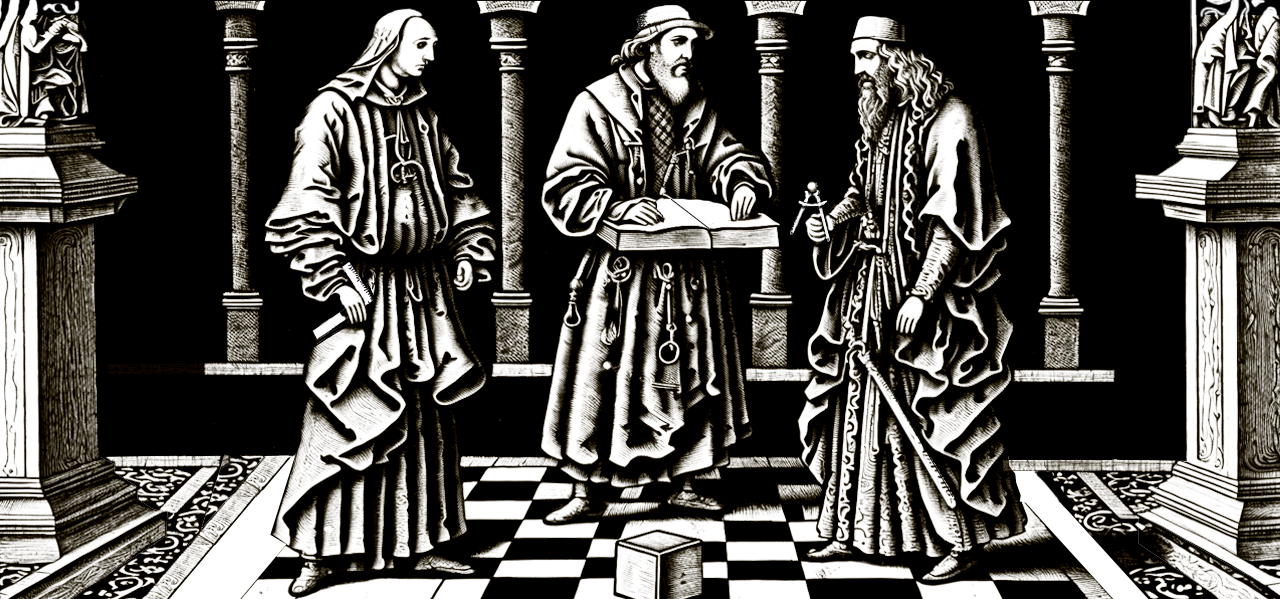
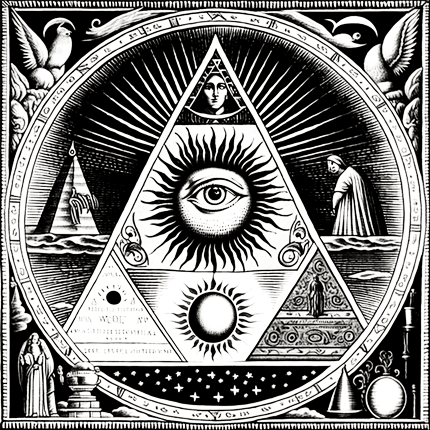
In creating the real history of humankind and their own history, Freemasons employ the social instruments for the "hewing" of the material world. The history of Freemasonry is the process of building a new world and perfecting one's own Self.
The Masonic tradition traces the emergence of the Brotherhood of Freemasons back to Hiram, the legendary builder of the Temple of Solomon, which was erected in Jerusalem. In raising this sacred structure, Hiram devised the rituals and divided his subordinates into three groups: apprentices, fellow craftsmen, and masters of the Free Masons.
In time, Freemasons interpreted building in a figurative sense, regarding themselves as masons of the inner Temple of man, masons of the magnificent Temple of civilization. The roots of the Masonic Order can be sought among the Pythagoreans and the early Christians. On ancient buildings one can see signs that are now associated with Freemasonry. These symbols arose in the milieu of medieval occultist-mystics, whose history and philosophy were also, in part, adopted by the Free Masons.
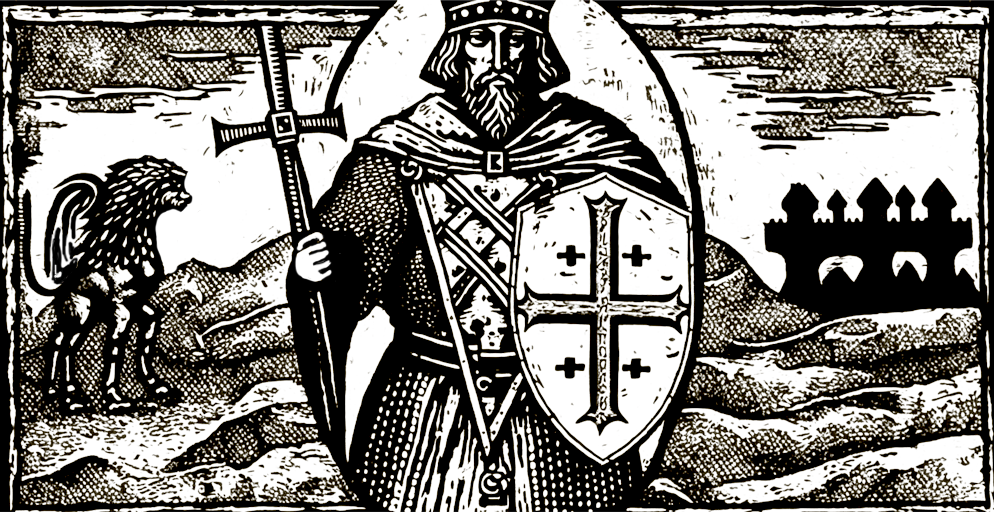
Freemasons call themselves knights, with traditions of nobility and chivalric fraternity. The monastic-knightly Order of the Poor Knights of Christ and the Temple of Solomon, named the Templars (founded in Jerusalem after the First Crusade), became an influential force in Europe in the twelfth century. The Templars were credited with possessing sacred secrets and great treasures. But in 1312, the French king Philip IV the Fair abolished this Order as heretical.
The erection of immense ecclesiastical buildings in the twelfth to fifteenth centuries lasted for centuries, during which the workers and architects settled near the buildings of their Temples (their building tools were kept in special houses, in English, the Lodge). They created a guild organization and worked out rules of relations, and established the ceremonial of the medieval builders' artels.
There is no confirmation of the existence of Masonic lodges before the fifteenth century, when they arose in Scotland and England, where the masons received in official acts the designation "Freemason." When the building societies began to decline, persons who did not belong to the building guild also began to gain access there - the so-called "outside masons," wealthy and renowned people, scholars, such as W. Schaw - the master of works, who oversaw the construction and repair of the royal castles at the court of King James I, or E. Ashmole (his entry into one of the English lodges in 1646 is recorded).
The philosophical lodges of the Free Masons arose from the "operative" (professional) building societies, scholarly societies, and esoteric circles of the humanists of the Modern era (the Royal Society of London). Freemasonry was formed under the influence of the ideas of J. Locke and T. Hobbes, C. L. Montesquieu and J. W. Goethe, B. Franklin, and T. Jefferson. In the Age of Enlightenment, Freemasons stood in defense of progress and fought against the influences of the papacy, which gave rise to several papal encyclicals against the Freemasons.
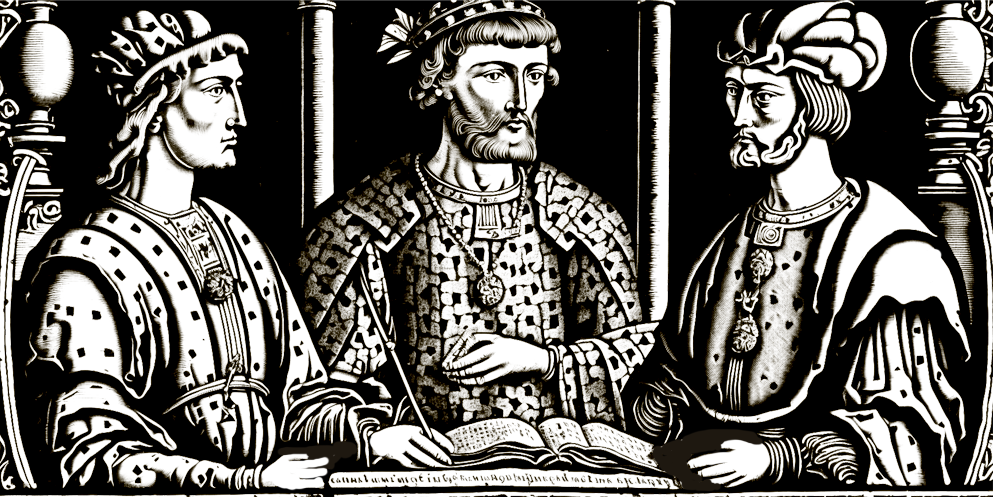
The Masonic Grand Lodge of England was founded in London on the day of Saint John the Baptist, June 24, 1717, when four London lodges gathered at a tavern in the courtyard of Saint Paul's Church in London and proclaimed the first grand lodge in history. In 1723, the First Constitution of the Grand Lodge of England by James Anderson was published.
The Masonic "Constitutions" (1723 and 1738), proclaiming the descent of Freemasons from the medieval guilds of the builders of Gothic cathedrals, devote considerable attention to the history of English, Scottish, and Irish architecture. As an example, the aspiration of the medieval builders to recreate the grandeur of the art of their ancient predecessors is presented.
In the 1720s-1750s, Masonic structures formed in almost all the countries of Europe and across the territories of North America. In the revolutionary events of the eighteenth and nineteenth centuries, historians trace the active participation of the Free Masons.
Freemasons were among the fighters for the independence of the United States, the countries of Latin America, Poland, and Ukraine, among the builders of the statehood of Italy, the authors of the Constitution of the United States and of many other countries; they overthrew the monarchy in France and Turkey, and formed new ideological conceptions and scholarly schools. The twentieth century gave rise to the Nazi and Communist regimes, which were equally intolerant of Freemasons. Thousands of Freemasons were repressed in the USSR, Germany, Spain, Italy...
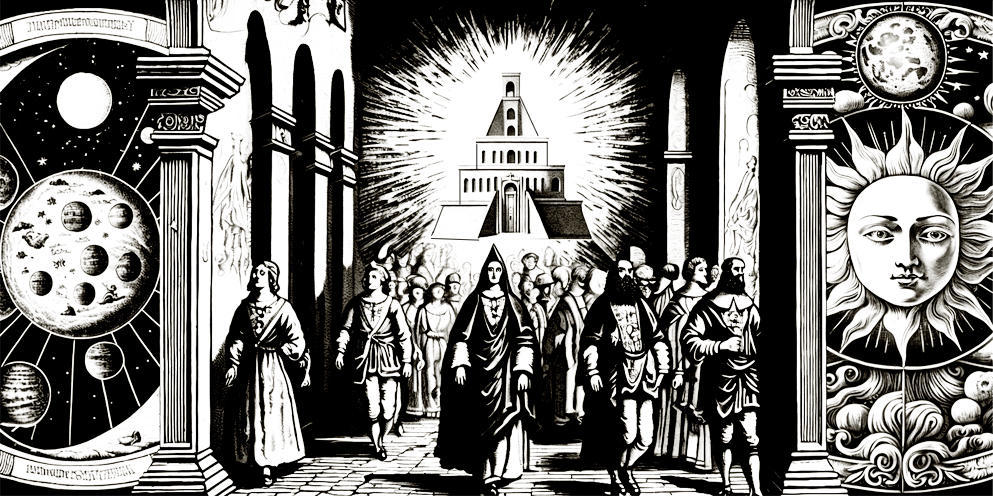
Today Freemasonry preserves its Order, authority, and influence in the "profane world"; in all, there are about 7 million Freemasons in the world, united in several dozen different Masonic orders - Grand Lodges (regular and irregular).
Among the Freemasons are presidents and physicians, senators and artists, generals and professors... The greatest Masonic authority in the modern world is the United Grand Lodge of England. In the United States there are more than 4 million Masonic brethren, in England and Scotland - 800 thousand, in Ireland - 45 thousand, in Canada - 250 thousand, in Australia - 120 thousand, in France - 70 thousand, in Italy - 30 thousand, in Germany - 20 thousand. In Asia and Africa there are about 300 thousand Freemasons, with the largest lodges located in India and Turkey.