




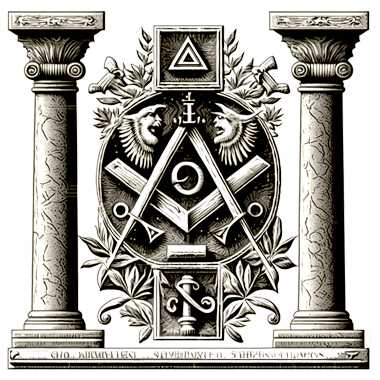
The founders of Freemasonry in Ukraine during the era of the Hetmanate were the Scottish Lord Kingston and Chancellor Jacob (James) Keith (James Francis Edward Keith) -- the younger brother of John Keith (Sir John Keith, 1st Earl of Kintore), a fighter for independence. As a Master Mason, James Keith took part in the Jacobite uprising in England in 1715, after which he emigrated to France, then to Spain, and in 1728 entered the service of the army of the Russian Empire, soon becoming a major general. In the 1730s, James Keith began to form the Masonic movement in Eastern Europe; he founded a Masonic lodge in Saint Petersburg and in 1739 became the Grand Provincial Master of Freemasonry of the Russian Empire. Over the following two years, Keith served as acting hetman of the Ukrainian Cossacks and headed the "Administration of the Hetman's Government" (the governance of Ukrainian autonomy within the empire). By his own example as a humane ruler, the Scotsman sought to defend the rights of Ukrainians within the empire. In the early 1740s, Keith initiated representatives of the Ukrainian Cossack aristocracy into Freemasonry; at the same time, several Ukrainian students studying at universities in Western Europe joined Freemasonry, and in Paris the son of the hetman of Ukraine in exile, Petro-Hryhorii Orlyk, became a Freemason.
James Keith maintained a secret connection with the Berlin lodge "The Three Globes," where in 1744 the future hetman of Ukraine, Kyrylo Rozumovskyi, was initiated into Freemasonry. A group of reformer-Freemasons from the Ukrainian nobility formed around the latter. They dreamed of reviving the independence of Ukraine, of setting Ukraine on the path of modernization, of introducing a "Constitution," of creating the first university in Ukraine, and they strove to shape public opinion. The Freemasons attempted to obtain official permission to open universities in Sumy, Katerynoslav, and Chernihiv, but Empress Catherine II restricted education in Ukraine, fearing to "enlighten" the colony.
The membership of Hryhorii Skovoroda -- the outstanding Ukrainian mystic, poet, and philosopher of the 18th century who received the nickname "Socrates" -- in the Masonic Order is still in doubt. It has been neither confirmed nor refuted. His works are imbued with Masonic ideas of the "building" of man and society, with the search for a religion of "love and virtue." The legacy of Hryhorii Skovoroda was propagated in Masonic circles, and one of the Ukrainian Masonic lodges was named after him.
Ukrainian Freemasons in the years 1770-1790 laid the foundations of science and art in Eastern Europe (the philosophers Petro Lodii and Pavlo Sokhatskyi, the historian Ivan Orlai, the physicians Danylo Samoilovych and Nestor Ambodyk-Maksymovych, the writers Alexei Pogorelsky and Ivan Kotliarevskyi (the creator of the Ukrainian literary language), the composers Dmytro Bortnianskyi, Maksym Berezovskyi, and Artem Vedel, the artists Volodymyr Borovykovskyi and Dmytro Levytskyi, and others). The Freemason Vasyl Kapnist, protesting against serfdom in the Russian Empire and paving the way toward the creation of an independent Ukraine, wrote the "Ode to Slavery" as a protest against the system of serfdom and the colonial status of Ukraine. The Ukrainian Freemason and jurist Semen Desnytskyi developed a project for the general transformation of the state order of the Russian Empire, taking European standards as a model.
In fact, the Masonic circle shaped the intelligentsia of Ukraine at the turn of the centuries. The philosopher Vasyl Zenkivskyi wrote that in the Freemasonry of Eastern Europe: "...all the principal features of the future progressive intelligentsia were formed -- in first place here stood the primacy of morality and the conscious service to society, and in general -- a practical idealism."***
The first lodges in Ukraine (which was then part of the Russian Empire) were the military "field" lodges. The military Lodge "Immortality" (Nemyriv-Kyiv) was founded in 1784 under the aegis of the Warsaw lodge "Catherine under the North Star," was subordinate to the "Grand Orient of Poland," but later worked in the first five degrees within the Union of Elagin lodges "Silence." It is possible that Hryhorii Skovoroda was a brother of this very lodge.
The fame of "the great Black Sea naval commander" in Ukraine was earned by the American Freemason John Paul Jones -- "the Black Corsair," the creator of the United States navy during the American Revolution. In 1788, Rear Admiral John Paul Jones, the commander of the Dnieper rowing military flotilla, defeated the Turkish fleet near Kherson. In Kyiv in 1788, the Lodge "Three Columns" arose, headed by Johann Georg Heinrich Ellisen -- a doctor of medicine and a renowned psychic healer. The Lodge "Dispelled Darkness -- Orient of Zhytomyr" operated in Zhytomyr during the years 1786-1793. This workshop was founded by the physician Franz Heynch. The workshop received its patent from the Provincial workshop "Perfect Secret" (of the "Polish Grand Orient").
In Kharkiv, the Scottish Masonic Lodge "Sincerity of Heart" existed from 1782 until the early 1790s. In the late 1780s, a Masonic Lodge also operated in Kremenchuk. In 1792, Catherine II issued a decree banning Freemasonry. The leaders of the Order were arrested or exiled. Freemasonry, crushed by Catherine II, voluntarily fell silent for several years, plunged into inactivity -- the lodges declined or were closed by order of the empress, and Masonic literature was destroyed.***
The first Masonic lodges in the lands of Western Ukraine (within the Polish-Lithuanian Commonwealth and the Austrian Empire) arose in the 1740s among the aristocracy. The first recorded Lodge of the Scottish Rite, "The Three Brothers," in the village of Vyshnivets in Volhynia, is mentioned under the year 1742. It was founded by the Polish general of French origin, Baron Pierre de Lefort, and Jan Mniszek -- the Grand Crown Hunter and Grand Chamberlain of Lithuania. Among others, this Lodge included Prince Michał Kazimierz Ogiński -- a descendant of the Ukrainian Vyshnevetskyi princes, one of the candidates for the Polish throne, a general, the hetman of the Grand Duchy of Lithuania and viceroy of Lithuania, a deputy of the Sejm, a composer, a virtuoso violinist, an artist, and a poet.
In 1747, the French Freemason Franz Longchamps de Bérier, a banker and member of the city government, created the lodge "The Three Goddesses" in Lviv. In 1767, he also founded the lodge "The Three White Eagles" of the Scottish system in Lviv (which operated until 1782). In 1776, the French abbot Baudin d'Arnaud founded the Rosicrucian lodge "The Three White Roses" in Lviv. During the years 1777-1782, the Lodge "Joseph to the Imperial Eagle" worked in Lviv (founded by Martin Josef von Klemens, a Swiss by origin). He subordinated the Lviv lodges "The Three White Eagles" and "The Three Standards" to the Masonic prefecture in Prague, which attempted to unify the Masonic lodges of Galicia by creating the Lviv Masonic District; however, the Polish Freemasons from the lodges of Galicia and from the Warsaw lodge "The Virtuous Sarmatian" resisted the transfer of the Freemasons of Galicia under Austrian administration.
The Lodge "Joseph to the Imperial Eagle" (which worked in Lviv in 1777-1782) was also being formed as the principal Lodge of Galicia, having received in 1778 from Vienna the patent of a "Mother Lodge" -- the governing body of six lodges of a special District ("Joseph to the Imperial Eagle," "The Three White Eagles," "The Three Standards," "The Golden Art," "To Hope," and "Hermann to the Black Turtle"). During the years 1779-1785, the Lodge "Perfect Equality" worked in Lviv. In 1782, the Lodges "Phoenix to the Round Table" and "Sincere Friendship" appeared there. In 1780, the Polish Freemasons received a patent from the "Grand Orient of France" to create a Masonic association in Galicia. The Lodge "Perfect Equality" created a structure independent and autonomous from the Austrian Freemasons -- the "National Orient of the Kingdom of Galicia and Lodomeria." The Lviv Lodge "Sincere Friendship" maintained contacts with the lodge "Perfect Equality"; the Lodge "The Three Crowns of Galicia" operated in 1780-1785 under the protectorate of the "Grand Orient of France." The Lodge "The Golden Art" worked in the town of Zalishchyky (1777-1778), and "To Hope" -- in Sambir (1777-1779). In 1780, the Lodge "Perfect Secret" was opened in Dubno. Four years later, this Lodge became the Provincial "Volhynian Lodge," under whose leadership seven lodges of Right-Bank Ukraine worked.
Under the leadership of the Lviv Masonic lodges, the Lodge "Absolute Fidelity" operated in Kamianets-Podilskyi, as well as a Lodge in the town of Panivtsi in Podillia. The Lodge "Absolute Fidelity" was opened in 1784 with the assistance of Stanisław Szczęsny Feliks Potocki, with whose name is associated the creation of the unique park-and-palace complex "Sofiivka" in the Uman region.
From the beginning of the 1780s, in the Masonic circles of Western Europe, and above all in Austria and Germany, "Reformist Freemasonry" began to take shape, supported by the philosophers and ideologues of the Masonic Order -- Johann Gottlieb Fichte, Johann Gottfried Herder, and the writers Johann Wolfgang von Goethe and Gotthold Ephraim Lessing. In 1785, the lecturers of Lviv University -- adherents of "reformist Freemasonry" -- left the Lodge "Phoenix to the Round Table" and founded the special university Lodge "The Sincere Person" (Lviv), which was headed by the philosopher Ignatius Aurelius Fessler. The Freemason-professors of Lviv University created in Lviv the "Ruthenian Institute" -- "Studium ruthenium."
An order of the Emperor of Austria from 1783 forbade the lodges of the Austrian Empire from submitting to the governing Masonic structures of other countries. After this, the Lodge "The Three Crowns of Galicia" severed its connection with the "Grand Orient of France." The Austrian authorities (in 1786) suspended the activity of the Lviv lodges, so that thereafter only the Lodge "The Sincere Person" worked relatively freely in Galicia. The Polish Lodge "Grand Orient" ceased to exist in 1794. And in 1795, Emperor Francis I banned Freemasonry throughout the entire territory of the Austrian Empire. Only seventeen years later did the secret Masonic lodges of Galicia "come out into the world."***
The era of 1802-1822 became the "golden age of Freemasonry." The grandiose projects of transforming the state and society, of educating a new person, of establishing parliamentarism and a Constitution, of freeing the peasants from serfdom -- everything the Freemasons proposed had a chance of changing the empire. In gymnasiums, lyceums, and universities, the Freemasons educated a new generation of the intelligentsia, which ensured a brilliant flourishing of culture and science.
The mystically inclined Russian Emperor Alexander I not only informally (without a corresponding decree) permitted the Masonic Order, but also unofficially approved Masonic activity in the empire. At that time, the young emperor of "great expectations" was surrounded by Freemason friends from the "Unofficial Committee." This group aimed to carry out global reforms (including in the ecclesiastical sphere) and a transition to a constitutional monarchy. In Ukraine, Masonic lodges worked in Kyiv, Odesa, Zhytomyr, Kharkiv, Kamianets-Podilskyi, Poltava, Feodosiia, and Katerynoslav. Most likely, lodges of Freemasons existed in Kremenchuk, Mykolaiv, Nizhyn, and Sevastopol.
In Kharkiv there operated the Lodge "The Dying Sphinx," which officially opened in 1816 (under the leadership of Zakhar Karnieiev), but as early as 1803 one can speak of the presence and existence of an "old" Masonic lodge in Kharkiv. The Kharkiv Freemasons contributed to the creation of Kharkiv University (which began its work in 1805). The patron of the Kharkiv educational district and university became the acting privy councilor, senator, count, and Freemason Seweryn Potocki. The brilliant writer, poet, and philosopher, and Freemason of the higher degrees, Johann Wolfgang von Goethe, took part in forming the teaching staff of Kharkiv University. On his recommendation, professors from Germany were invited to Kharkiv.
In Kharkiv, the Freemasons organized the public for the publication of the first Ukrainian journal "The Ukrainian Herald" and the satirical-humorous journal "The Kharkiv Democritus." From 1817, the patron of the Kharkiv educational district and Kharkiv University became the Freemason Zakhar Karnieiev -- a senator, a member of the State Council and of the Commission for the Drafting of the Laws of the empire.
The Freemasons applied great effort to the opening of the Nizhyn Gymnasium of Higher Sciences, where in 1821 the Freemason and doctor of philosophy and medicine Ivan Orlai de Carvo became director. He worked in this position until 1826, and then was transferred to the position of director of the Richelieu Lyceum in Odesa.
In Poltava at the beginning of the 19th century (officially from 1818), the Masonic Lodge "Love of Truth" of the union "Astraea" operated. The Worshipful Master of the Lodge was Serhii Kochubei (the Poltava provincial marshal, a member of the "Little Russian Secret Society"). One of the organizers of the Lodge was the general, Prince Mykola Repnin-Volkonskyi, who was suspected of "Ukrainophilism," with hints made about him as a "second Mazepa." Among the members of the Lodge was also the historian Dmytro Bantysh-Kamenskyi -- the creator of the "History of Little Russia." But the most famous Freemason of Poltava was the poet and playwright Ivan Kotliarevskyi. Another classic of Ukrainian literature, Petro Hulak-Artemovskyi, belonged to the Kharkiv Lodge "The Dying Sphinx."
In those same years, the Masonic Lodge "United Slavs" worked in Kyiv -- whose secret "curator" was Mykola Repnin-Volkonskyi, and one of whose brethren was Count Gustaw Henryk Atanazy Olizar -- a poet and a member of the Polish "Patriotic Society." The revival of the Zhytomyr lodge "Dispelled Darkness" took place in 1815, and by the beginning of 1822 it already numbered more than 100 brethren. In Feodosiia, from 1812, the Lodge "Jordan" worked. In Kamianets-Podilskyi until 1822, the Lodge "Osiris to the Flaming Star" operated (the Lodge included about 150 persons), and in the town of Butsniv -- the Lodge "Minerva."***
The brethren planned to make Odesa the Masonic "city upon a hill," and they began to develop it in the mid-1790s. In 1794, Vice Admiral and Freemason José de Ribas became the chief initiator of the city's planning. During the years 1803-1814, Odesa was governed by the Freemason Armand Emmanuel Sophie Septemanie de Vignerot du Plessis, duc d'Aiguillon, duc de Fronsac, duc de Richelieu. In Odesa he cultivated the planting of the "Masonic" tree -- the acacia. In the time of de Richelieu, a Masonic Lodge operated in Odesa. It is no coincidence that Leo Tolstoy, in the novel "War and Peace," wrote that in 1807 it was the Odesa Freemasons who gave Pierre Bezukhov a letter of recommendation for his entry into the Order.
After the victory of the coalition forces over Napoleon, de Richelieu returned to France (in 1815-1818 and 1820-1821 he was prime minister of France), entrusting the governorship of Odesa to the Freemason and major general of Scottish origin Tomas Cobley, and the military command to the general and Freemason Mykhailo Borozdin. In 1815, at de Richelieu's request, the emperor appointed the Freemason Count Louis Alexandre Andrault de Langeron as governor of Odesa (1815-1820) and governor-general of the South (1815-1822). De Langeron established in Odesa the system of "free trade" -- porto-franco, opened the Richelieu Lyceum, created a botanical garden, laid out the Prymorskyi Boulevard, and initiated the appearance of the first city newspaper...
By 1822, the Masonic lodges "The Three Kingdoms of Nature -- Friends of Nature" (a Lodge of the higher degrees), "Pontus Euxinus," "The Lodge of French and Italian Literature," and "The Anatolian Lodge" operated in Odesa. The founder and Worshipful Master of the Lodge "Pontus Euxinus" was de Langeron (the Lodge had nearly 200 brethren). From 1814, the secret Greek para-Masonic Lodge "Filiki Eteria" ("Friendly Society") began to take shape in Odesa, which played a great role in the restoration of Greek statehood.
The Richelieu Lyceum, as a center of education in Odesa, was created by the Freemasons de Richelieu, de Langeron, and Abbot Nicole. It was therefore no coincidence that the majority of the lyceum's professors were Freemasons from Italy, Switzerland, Germany, and Austria. In 1825-1826, the professor of theology, archimandrite, and Freemason Feofil temporarily served as acting director of the lyceum. In July 1822, the Freemason and general Ivan Inzov became the administrator of the region. He was also the chief trustee of the foreign colonists of the South of Russia and the viceroy of the Bessarabia province. From 1823, the Freemason, count, and general Mykhailo Vorontsov became governor-general of New Russia.
In 1815-1822, Polish Masonic lodges operated in the Kyiv, Podillia, and Volhynia provinces. In Dubno the Grand Provincial Lodge "Perfect Secret" -- the "Volhynian Lodge" -- was created, which became the territorial union of the lodges of Right-Bank Ukraine within the system of the "Grand Orient of Poland." In Dubno and Lutsk the Lodge "The Eastern Morning Star" ("Star of the Orient") worked, in Rafalivka -- the Lodge "Crowned Virtue under Three Stars," in Ostroh -- the Lodge "The Virtuous Pole," and in Tulchyn -- the Lodge "True Patriotism." Polish lodges worked in Vinnytsia, Rivne, and Chudniv.***
The Masonic lodges in Ukraine at the beginning of the 19th century were a unique social structure in which people of different political convictions, life experiences, nationalities, faiths, ages, social standing, professions, ranks, and titles interacted. Such a "public organization" was called upon to shape the spiritual aspirations of a generation and to emancipate the empire. However, on August 1, 1822, Alexander I signed the rescript "On the Abolition of Masonic Lodges and of All Secret Societies," after which all the lodges in the empire were officially closed. In 1824, the emperor confirmed the ban on Freemasonry. This ban struck above all at the open Masonic structures of the first three degrees. But the Freemasons of the higher degrees continued their secret activity. Among the Masonic lodges that operated after the new ban of 1826, lodges are known in Kyiv, Odesa, and Zhytomyr.
During the Polish uprising of 1830-1831, an attempt was made to revive the Polish "Grand Orient" in Right-Bank Ukraine. In 1833, the secret Lodge "Crowned Virtue" operated in Rivne. Among the Odesa Freemasons of the time of the ban, Count Kyrylo Razumovskyi -- the grandson of the hetman of Ukraine -- is known. In 1845-1875, conspiratorial Masonic lodges existed in Odesa: "The Anatolian Lodge," "The Seaside Lodge," and "The Star of Justice." The Lodge "Revival of the Proselyte Orient" worked in Izmail.
Freemasons (the artist K. Briullov, the poet V. Zhukovskyi, Count Mykhailo Vielhorskyi, Count F. Tolstoy, and P. Martos) organized the liberation of the Ukrainian genius, poet, and artist Taras Shevchenko from serfdom and helped him publish his first book of poetry, "Kobzar." Freemasons also included the Ukrainian political figure and social theorist Mykhailo Drahomanov and the renowned writer and philosopher Ivan Franko (Franko's programmatic poem "The Stonecutter" is worth regarding as Masonic).***
A new stage in the development of Freemasonry in Ukraine began in the first years of the 20th century. In Ukraine, which was then part of the Russian Empire, the systems of traditional lodges of the Old Scottish Rite were established, which in 1900 (according to other sources, in 1902) created the "Grand Lodge of Ukraine." The lodges of the Masonic-Martinist Order and the lodges of "political" Freemasonry were dependent on the French "Grand Orient," as was the esoteric Lodge "Order of the Star in the Orient." The "Grand Lodge of Ukraine" included the lodges: "Dispelled Darkness," which had revived in Zhytomyr; "Osiris" -- in Kamianets-Podilskyi; "Shevchenko" -- in Kharkiv; "Immortality" -- in Kyiv; "Love and Fidelity" -- in Poltava; "Brotherhood" -- in Chernihiv; and "Pontus Euxinus" -- in Odesa.
In 1906, the renowned Ukrainian sociologist and jurist, Professor Maksym Kovalevskyi, opened a new Masonic lodge in Saint Petersburg, into the membership of which natives of Ukraine also entered, and two years later they created the "Supreme Council of Russian Masonic Lodges" within the sphere of influence of the "Grand Orient of France." Soon dozens of lodges had already been opened in the empire, including in Kyiv and Odesa. The "Supreme and Ruling Chapter -- Narcissus" was founded in 1912 in Ukraine under the curatorship and with the recognition of the "Grand Lodge of Italy" -- "for the works of the higher degrees of the mystical order of the Martinist-Rosicrucians." It included the lodges: "Saint Volodymyr the Equal-to-the-Apostles" (Kyiv), "Saint Andrew the First-Called" (Kyiv), "The Northern Lights" (Kyiv), "United Slavs" (Kyiv), and "Saints Cyril and Methodius" (Poltava).
The number of Freemason brethren in the Ukrainian provinces of the Russian Empire before the coup of 1917 was about 400 men. In Kyiv alone there were 15 lodges of various orientations, and about 30 more operated throughout Ukraine. Among the Freemasons of the early 20th century, the elite of the urban intelligentsia and the bourgeoisie (industrialists, bankers, lawyers, journalists, professors, public and political figures, and members of the zemstvos) united. They were proponents of global socio-political changes in the empire. In 1913-1916, the curator of Ukrainian Freemasonry on behalf of the Masonic Convent (Congress) of the "Grand Orient of the Peoples of Russia" was the future leader Alexander Kerensky. In 1914, the Regional Council of Masonic Organizations of the "Grand Orient of the Peoples of Russia" was created in Kyiv (an autonomous Masonic Province -- a District for the Ukrainian lodges). In Kyiv, the Masonic Lodge of the higher degrees "The Kyiv Dawn -- Truth" ("The Dawn -- The Light of Truth") was established, which included Mykhailo Hrushevskyi, Serhii Yefremov, Andrii Nikovskyi, and other figures who in 1917 created the Ukrainian People's Republic. The professor and historian Mykhailo Hrushevskyi held authority for the Ukrainian intelligentsia and retained leadership among the Ukrainian Freemasons right up until 1918.
In the 1910s, the lodges "Unity," "Federation," "Dawn," "Truth," and "Astraea" likewise operated in Kyiv. Until 1917, Masonic lodges also existed in Poltava, Vinnytsia, Katerynoslav, Odesa, Kharkiv, Zhytomyr, Berdychiv, Chernihiv, and Rivne. The Kharkiv Lodge "Revival" enjoyed great influence. In Odesa, in 1909-1917, the Masonic movement was represented by the lodges: "Saint Jordan," "Dante Alighieri," "Star of the Orient," and "Truth." Among the Odesa Freemasons one can point to the renowned professors of mathematics Ivan Tymchenko and Samuil Shatunovskyi, and Volodymyr Chekhivskyi -- in 1918-1919 prime minister of the Ukrainian People's Republic.***
In the summer of 1916, the All-Russian Masonic Convent of the "Grand Orient of the Peoples of Russia" placed on the agenda the preparation for the liquidation of the monarchy of Emperor Nicholas II. After the February coup of 1917, the Freemasons filled the composition of the first and second ministries of the Provisional Government of Russia. The Freemasons took the positions of commissars of the Provisional Government in the provinces and metropolises. They headed the new revolutionary authority in Kyiv -- the Executive Committee of the Council of United Public Organizations. In Ukraine, members of the Brotherhood became provincial commissars, commissars of large cities, heads of military districts, the new leaders of the local Dumas, and heads of the judicial chambers. Thus, Mykhailo Hrushevskyi became chairman of the Central Rada, Andrii Nikovskyi -- deputy chairman of the Central Rada, and Fedir Shteinhel -- a member of the National Congress and chairman of the executive committee of the Kyiv Duma.
In the first government of the Central Rada, out of 12 members, half were Freemasons; in the next cabinet -- 6 Freemasons out of 11 members of the government; in the third cabinet -- 9 ministers out of 17 members. With the beginning of 1918, the influence of the Freemasons in Ukraine began to decline -- in the cabinet of the Socialist-Revolutionary V. Holubovych there was not a single Freemason (this cabinet signed the peace of the Ukrainian People's Republic with the German bloc). In 1918, the rights of the "Supreme Council of the Grand Orient of the Peoples of Eastern Europe" passed to the Kyiv Regional Council of Masonic Organizations of the "Grand Orient of the Peoples of Eastern Europe." In 1917, 15 lodges united into the "Kyiv Brotherhood" and organized the new Lodge "Young Ukraine."
In October 1917, the Ukrainian Freemason of the higher degrees Symon Petliura became Secretary General (minister) of military affairs of the Ukrainian People's Republic. He was able to avert a Bolshevik coup in Kyiv, began to form the armed forces of Ukraine, and after his resignation in December 1917 organized troops for the struggle against the Red Moscow forces.
In the spring of 1918, when the Central Rada was once again established in Kyiv, the recreation of an independent national Masonic system began. Soon, power in Ukraine passed to the Freemason Pavlo Skoropadskyi, who proclaimed himself Hetman of the Ukrainian State. On May 1, 1918, the hetman appointed Mykola Vasylenko (the head of the Kyiv Lodge "Astraea") as acting chairman of the Council of Ministers. Soon the hetman appointed a new cabinet of ministers, in which, out of 14 ministers, half were Freemasons, and in the subsequent hetman's cabinet they made up 30%. The head of the Masonic Chapter "United Slavs -- Narcissus," Serhii Morkotun, in the autumn of 1918 prepared the opening, on the basis of the Chapter, of the "Grand Lodge of Ukraine -- United Slavs," proclaiming himself Grand Master. Symon Petliura, who headed that part of the Freemasons which opposed Skoropadskyi, attempted to create a "Grand Lodge of Ukraine" under his own leadership. With the transfer of power in Ukraine to the Directory of the Ukrainian People's Republic (from December 13, 1918) and the overthrow of the hetman, the Ukrainian Freemasons -- adherents of the "Petliura line" -- headed the ministries (the commander of the troops and member of the Directory Symon Petliura, the prime minister Volodymyr Chekhivskyi, the minister of education Petro Kholodnyi, the minister of justice Oleksandr Shelukhin, and others). In the second half of February 1919, Symon Petliura became the head of the Directory of the Ukrainian People's Republic.
In April 1919, the creation of the "Grand Lodge of Ukraine" "Saint Andrew the First-Called" was proclaimed in Kamianets-Podilskyi, the Grand Master of which became Symon Petliura. There is information that this Grand Lodge had 7 local lodges, 83 Masonic circles, and about 800 brethren. The GLU issued a manifesto in which it appealed to all the Free Masonic jurisdictions of the world for recognition. The manifesto was signed by: S. Petliura -- Grand Master of the GLU; V. Petriv -- 1st Grand Warden; F. Moret -- 2nd Grand Warden; A. Livytskyi -- Grand Secretary ("Bulletin du Bureau international de relations maconniques," No. 4 of 1919). The GLU appealed to the French Freemasons, to the Grand Master of the "Grand Lodge of Switzerland," and to the chancellor of the "International Masonic Association" with a request to facilitate the international recognition of Ukrainian statehood and of the "Grand Lodge of Ukraine," endowed with "supreme Masonic authority and independent power on the territory of the Ukrainian Republic." Symon Petliura believed that Ukraine should become an example of a "Masonic republic." There is information that the "Grand Lodge of Switzerland" and the "Grand Orient of Romania" recognized the "GLU," but other Masonic structures refused recognition. During the years 1919-1920, the head of the Directory of the Ukrainian People's Republic, Symon Petliura, formed cabinets of ministers of the Ukrainian People's Republic, in which the prime ministers were the Freemasons V. Prokopovych and A. Livytskyi. The Freemasons O. Shulhyn, P. Salikovskyi, P. Kholodnyi, and A. Nikovskyi held ministerial positions.***
In Western Ukraine, which was under the rule of the Austro-Hungarian Empire, Masonic lodges were formally banned until the collapse of that empire in the autumn of 1918. But secret lodges existed at that time in Lviv (the Lodge "New Poland") and, possibly, in Chernivtsi. Ivan Franko was a member of one of the Lviv lodges, "Sarmatia." It is known that in Lviv in 1918-1919 there existed the Ukrainian Masonic Lodge "Unity."
The "Red Terror" of 1918-1921 and the rout of the anti-Bolshevik forces led to the destruction of all the political opponents of the Bolsheviks, among whom there were many Freemasons. From November 1920, one can no longer speak of an organized Masonic movement in Soviet Ukraine, of the work of Masonic lodges, chapters, and orders. Faint hints of the continuation of secret Masonic activity in the 1920s concern Kyiv, Odesa, and Kharkiv, where several closed underground Masonic circles united the old Freemasons. There is evidence that the Masonic lodges "The Light of Truth," "The Dawn," and "Daybreak" operated in Soviet Kyiv right up until 1929. By this time, a Martinist lodge also existed in Kyiv. The last data about the Freemasons in Ukraine in the first third of the 20th century concern 1933. At that time, the Kyiv Freemasons appealed to the "International Masonic Association" with a protest against the Holodomor -- the extermination of the Ukrainian peasantry.***
From 1921, Ukrainian Freemasons gathered in Paris around the leaders Serhii Morkotun and Mykola Shumnitskyi (a member of the Ukrainian diplomatic mission of the Ukrainian People's Republic in France), and in Poland -- around Symon Petliura (the "Ukrainian Lodge"), who took with him to Poland, and then to France, the archive and relics of the "Grand Lodge of Ukraine." After Symon Petliura's move to Paris in 1925, the "Supreme Council of the Grand Lodge of Ukraine" was founded there, which united the Ukrainian Freemason émigrés from France, Switzerland, Romania, Austria, and Poland. After the death of S. Petliura, S. Kotliarevskyi became Grand Master of the GLU.
In the 1920s, in Warsaw-Tarnów-Kalisz, the Ukrainian-Polish Lodge "Unity" existed (it belonged to the Grand Lodge "United Poles"). The Worshipful Master of the lodge was Stanisław Stempowski (the minister of land affairs of the Ukrainian People's Republic, who later became Grand Master of the Grand Lodge of Poland and Grand Commander of the Supreme Council of the Ancient and Accepted Scottish Rite for Poland). In the 1920s and 1930s, Masonic lodges worked in Uzhhorod, Mukachevo, and Berehove. The International Masonic Association in Geneva gave refuge to the headquarters of the GLU (in 1932 the GLU dissolved itself). In 1925, Professor Mykhailo Chubynskyi, the former minister of justice of the Ukrainian State (the son of Pavlo Chubynskyi, the author of the words of the national anthem), joined the Masonic lodge "Sworn Brother" (Belgrade). M. Chubynskyi became a Grand Officer of the Grand Lodge of Yugoslavia. In 1926, Ukrainian émigrés founded the lodge "Maksym Kovalevskyi" in Belgrade.
In 1937, the Romanian King Carol II issued an order banning Freemasonry in Romania. All the local Masonic lodges, including the "Grand Lodge of Romania," were dissolved (at that time the Ukrainian lands of Bukovyna and Southern Bessarabia were under Romanian rule, and a Masonic Lodge worked in Chernivtsi). And in 1938, a law banning Masonic lodges was issued in Poland, so that the "Grand National Lodge of Poland" was then dissolved (the Ukrainian lands of Eastern Galicia and Volhynia were part of Poland, and Masonic lodges existed in Lviv and Stanislaviv).
In the 1920s-1960s, the united Russian-Polish-Ukrainian lodges "Astraea" and "Gamayun" existed in France, in which Freemason émigrés of the "first wave" were involved. From the active members of these lodges, a circle of Ukrainian Freemasons was formed: Serhii Tatarula (the first Worshipful Master of the lodge "The Voice of Ukraine" ("VU")), Yaroslav Musianovych (Worshipful Master of "VU" in 1970-72), Bohdan Fedenko (Worshipful Master of "VU" in 1967-69), Liubomyr-Yevhen Huzar, the brothers Aristid and Themistocles Virsta, and others. On January 17, 1966, they founded the lodge "The Voice of Ukraine" No. 117 of the Province of "Neustria" (the lodge's work was based on the Scottish Rite, but it was conducted in the Ukrainian language). The lodge "The Voice of Ukraine" in Paris exists to this day and belongs to the Province of "Lutetia" of the Grand National Lodge of France (GNLF).***
In Ukraine, the process of the revival of Freemasonry began only after 1991, and the Paris lodge "The Voice of Ukraine" played a distinguished role here, becoming the connecting link in the Masonic movement, passing on the traditions of the Freemasons to a new generation of Freemasons in Ukraine. In 1993, the GNLF in Paris opened the lodge "Three Columns" No. 785 for the formation of Freemasonry in Ukraine. Several residents of Lviv and Kyiv became the first members of this lodge. From 1996, the lodge "Three Columns" began to work in Kyiv, headed by a Ukrainian Worshipful Master and Freemasons from Kyiv, Lviv, Odesa, and Kharkiv. During the Masonic works in the lodge "Three Columns," the collars (regalia) of the Ukrainian Freemasons of the early 20th century were used (including the collars of Symon Petliura -- Grand Master of the "Grand Lodge of Ukraine," which had been preserved in France).
In 1998, the lodge "Phoenix of Ukraine" was created in Kharkiv; in the autumn of 1999, the lodge "The Stonecutter" was opened in Lviv; and in the autumn of 2000, in Odesa -- "The Golden Acacia." On the basis of the four Ukrainian lodges (of Kyiv, Kharkiv, Odesa, and Lviv), which had previously been in the Province of "Lutetia" of the GNLF, the District "Ukraine" of the GNLF was created, which was headed by a Ukrainian Grand Provincial Master. French Freemasons of the highest degrees of Ukrainian origin from the lodge "The Voice of Ukraine" especially assisted in the restoration of Freemasonry in Ukraine: Liubomyr-Yevhen Huzar, Yaroslav Musianovych, Marian Kuzan, Themistocles Virsta, Volodymyr Hrynchuk, and Ivan Kirstiuk.
The Grand Master, in his address to the visitors of the Ukrainian Masonic website www.ukrmason.org, wrote: "In systemic matters (and Freemasonry is a very systemic affair) accidents are the exception. Therefore it is no coincidence that the most Masonic cities of Ukraine are Kyiv, Kharkiv, Odesa, and Lviv: it is there that the majority of the brethren of all jurisdictions live and work. The reasons for this lie in the traditions of the spiritual and intellectual culture of these magnificent cities, and that is why they are even now the most open to us."
On September 24, 2005, in Paris, in its magnificent temple, the "Grand National Lodge of France," together with the "Grand Lodge of Austria," consecrated the "Grand Lodge of Ukraine" (the former District within the system of the GNLF), created with the support of brethren from France and Austria. The Most Worshipful Brother Jean-Charles Foellner, Grand Master of the GNLF, conducted the consecration, in which he was assisted by the Most Worshipful Brother Michael Kraus, Grand Master of the Grand Lodge of Austria (First Grand Consecrating Warden), and the Most Worshipful Brother Jean-Claude Tardivat (Second Grand Consecrating Warden). Present at the ceremony of the creation of the "Grand Lodge of Ukraine" were foreign delegations: of Austria, Belgium, Canada (Quebec), Latvia, Morocco, Moldova, Germany, Poland, Portugal, Romania, Serbia and Montenegro, Turkey, Hungary, and the Czech Republic.
The new "Grand Lodge of Ukraine" consisted of four lodges of the former District "Ukraine" and the Lodge "Light," which was created in Lviv by Austrian Freemasons from Vienna. The new system was soon joined by the sixth lodge, from Ivano-Frankivsk, "Imhotep to the Flaming Star," created in 2006.
After 2006, Ukrainian regular Freemasonry of the "GLU" of the Ancient and Accepted Scottish Rite was augmented by the lodges: "Yurii Kotermak" No. 7 (Drohobych), "Immortality" No. 8 (Kyiv), "Langeron" No. 9 (Odesa), and "Hryhorii Skovoroda" No. 11 (Kyiv). The Grand Lodge of Ukraine began to develop regular Freemasonry in Georgia, creating within its system the lodges with Georgian brethren "Saint George" No. 10 (Tbilisi) and "Elias the Righteous" No. 12 (Tbilisi), striving to establish a "Grand Lodge of Georgia." In 2011, the structure of the higher degrees (from the 4th to the 33rd degree) of world Freemasonry was established for Ukraine. During the consecration of the Supreme Council of Inspectors General of the 33rd and last degree of the Ancient and Accepted Scottish Rite (AASR), a Ukrainian Sovereign Grand Commander (the chief leader of the higher Masonic degrees) was appointed for Ukraine. In Ukraine there were also created the Lodges of Perfection (4th-14th degrees), the Chapter (14th-18th degrees), the Areopagus (19th-30th degrees), the Tribunal (31st degree), the Consistory (32nd degree), and the Supreme Council of the Ancient and Accepted Scottish Rite (33rd degree).