




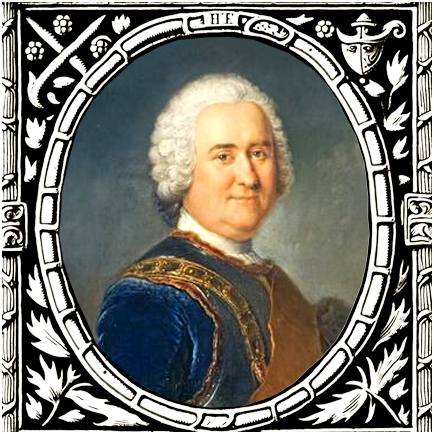
James (Jacob) Keith
James Francis Edward Keith
1696-1758
The founder of Freemasonry in Ukraine, the Scottish Lord Kingston and Cantor, the younger brother of John Keith - a champion of the independence of Scotland and the Grand Masonic Grand Master of England and Scotland. During his studies at the University of Edinburgh he acquired a taste for literature and the sciences, which earned him the respect of the eminent scholars of Europe. Jacob (James) Keith took part in the unsuccessful "Jacobite" uprising in England in 1815, after which he emigrated to France, and then to Spain. In 1728 he entered the service of the army of the Russian Empire and received the rank of lieutenant colonel, and later that of major general. In the 1730s Jacob Keith began to form the Masonic movement in Eastern Europe, founded a Masonic lodge in Saint Petersburg, and in 1739 became the Grand Provincial Master of Freemasonry of the Russian Empire. Over the next two years Keith was the acting hetman of the Ukrainian Cossacks and headed the "Administration of the Hetman Government" (the administration of Ukrainian autonomy within the empire). By his own example as a humane ruler, the Scotsman sought to defend the rights of Ukrainians within the empire. From the beginning of the 1740s Keith initiated representatives of the Ukrainian Cossack aristocracy into Freemasonry. At the same time several Ukrainian students who were studying at the universities of Western Europe joined Freemasonry; in Paris the son of the hetman of Ukraine in exile, Petro-Hryhorii Orlyk, became a Freemason.
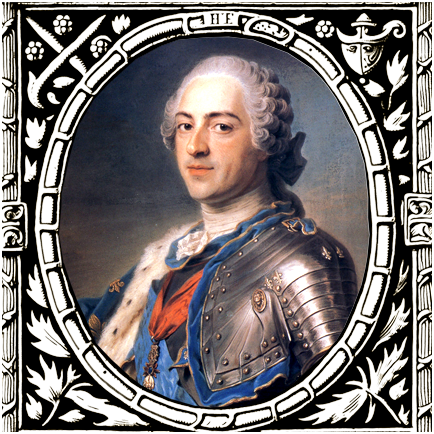
Hryhorii Orlyk
1702-1759
The son of Pylyp Orlyk and the godson of Hetman Ivan Mazepa, Hryhorii Orlyk studied at the University of Lund and lived for a long time in Sweden and Saxony. But in the end he settled in France, where he became a Freemason, received the title of Count de Lazisky Dentville, the rank of lieutenant general of the army of the King of France, adjutant general of the King of Poland in exile Stanislaus Leszczynski, was a member of the "Secret Cabinet" of King Louis XV, and a diplomat.
Hryhorii Orlyk - commander of the elite regiment of the "Blue Swedes" of the French army, holder of the orders of the "Cross of Saint Louis," the "Sword of Sweden," the "White Eagle" …
He dreamed of forming a coalition of France, Sweden, the Polish-Lithuanian Commonwealth, and the Ottoman Porte that would destroy the might of the Russian Empire and ensure the separation of the Hetmanate from the empire. In 1734 H. Orlyk secretly came to Ukraine for negotiations with the officers of the Zaporozhians and the registered Cossacks.
All his life Hryhorii Orlyk hoped to become the hetman of an independent Ukraine - of the "Cossack Zaporozhian nation," which was oriented toward the Treaty of Hadiach. He was declared an outlaw on the territory of the Russian Empire.
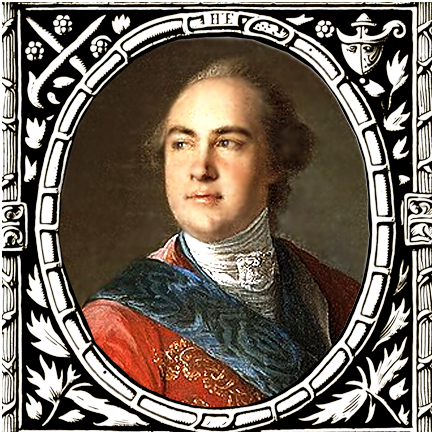
Kyrylo Hryhorovych Rozumovsky
1728-1803
Ukrainian hetman, count - patron of the sciences and the arts, friend of the composer W. A. Mozart. In 1743 K. Rozumovsky was sent abroad, where he studied at the universities of Germany, France, and Italy. In 1744 the student Kyrylo Rozumovsky, who was traveling through Europe, was admitted into Freemasonry in Berlin in the Lodge of the "Three Globes" by the King of Prussia (Rozumovsky was admitted into the Order at the age of 16 - an exceptional case in Freemasonry).
The King of Prussia, Frederick II, was a supporter of the Masonic reformation of the Scottish Rite, Ancient and Accepted - "Ritus Scoticus, Antiquus et Acceptus." After the founding of the Grand Lodge of the "Three Globes," Frederick II became its patron. Having returned to the Russian Empire, Rozumovsky advanced successfully up the career ladder.
In 1744 he was granted the title of count, in 1746 he became President of the Academy of Sciences, in 1748 a general, and in 1750 the hetman of Ukraine (he ruled the Hetmanate until 1764). Around K. Rozumovsky a group of reformer-Freemasons from the Ukrainian nobility was formed. They dreamed of transforming the Cossacks into a knightly order, sought to create the first university in Ukraine, and to revive the liberties of Ukraine. Rozumovsky sought to open universities in Baturyn and Kyiv and to develop enlightenment in the Hetmanate.
Among the Masonic "fledglings" of Kyrylo Rozumovsky were the diplomat V. Tomara, V. Kochubei, F. Lubianovsky. There is a supposition that the "secret lodge" of Rozumovsky included representatives of the Ukrainian nobility: the Kapnists, the Kovalynskys, the Kuliabkas, the Lomykovskys, the Lukashevychs, the Poletykas, the Rodziankos, the Skoropadskys, the Sulymas, the Tarnovskys, the Troshchynskys, the Tumanskys, the Khanenkos…
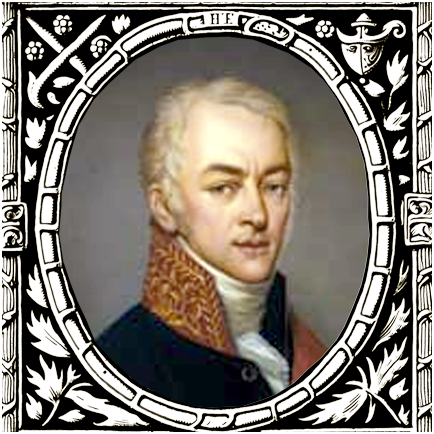
Oleksii Kyrylovych Rozumovsky
1748-1822
Ukrainian hetman, count, the eldest son of the hetman, the father of the renowned writer Antonii Pohorilsky, the great-grandfather of Sofia Perovska; he received his education in England, where he joined the Freemasons.
Having returned from Europe, in 1771 Oleksii joined the Saint Petersburg Masonic Lodge of the "Perfect Union" of the English system, where the Worshipful Master was the Englishman John Cayley.
Together with his father, in the mid-1770s Oleksii Rozumovsky was a member of the Lodge of the "Three Muses" in Saint Petersburg (a Lodge of the English system). Subsequently O. Rozumovsky became a member of the chapter "Phoenix," which governed the Masonic movement in the Russian Empire, was a member of the chapter of the Strict Observance of the system of the Templars of J. Starck, vice-president of the Russian Bible Society, trustee of Moscow University, a member of the Main Administration of Schools, president of the Society of Naturalists, and trustee of the Free Society of Lovers of Literature.
In the era of Alexander I, O. Rozumovsky was Minister of Public Education (1810-16), promoted the creation of a network of primary schools and gymnasiums, assembled the largest library in the empire on natural science, and created a botanical garden. From 1818 Oleksii Rozumovsky lived on his estate of Pochep in the Chernihiv Governorate and was an Honorary member of Kharkiv University.
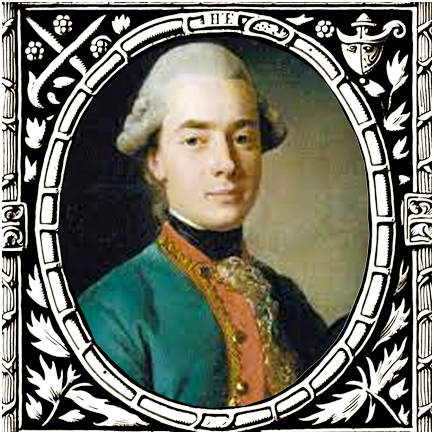
Andrii Kyrylovych Rozumovsky
1752-1836
Count, His Serene Highness the Prince. In his youth, while serving in the Russian navy, he became a member of the Masonic Order. He had a "particular influence" over the tsarevich Pavel Petrovich. This fact troubled Catherine II, and she sent Andrii Rozumovsky as Russian envoy to the Kingdom of Naples (he served in Naples in 1777-84), and then as ambassador to Sweden (1786-88).
There he established friendly relations with the King of Sweden - the leader of the local Freemasonry, Gustav III (a potential adversary of the Russian Empire), which aroused great agitation and suspicion in the empress.
He was sent as ambassador to Austria (1790-1799, 1801-1807). A splendid violinist, A. Rozumovsky was on friendly terms with Haydn, Mozart, and Beethoven (Beethoven dedicated to A. Rozumovsky three string quartets, opus 59, as well as the fifth and sixth symphonies).
In 1787, in a letter to G. Potemkin, Andrii Rozumovsky reported: "I had wished to send to you the foremost pianist and one of the best composers in Germany - Mozart. He is dissatisfied with his position here and would gladly make this journey." But Wolfgang Amadeus Mozart, who had been promised in Ukraine the post of professor of the conservatory and conductor of the orchestra, was prevented from coming to Yekaterinoslav by an illness, during which he wrote "The Magic Flute."
Pavel I ordered A. Rozumovsky to leave Vienna and move into "exile" in the Ukrainian Baturyn.
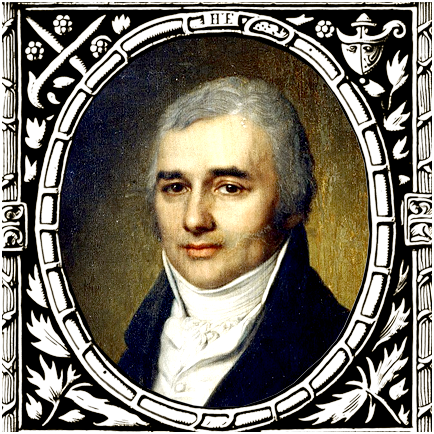
Lev Kyrylovych Rozumovsky
1757-1818
He studied abroad together with his brothers - in England, Germany, France, Switzerland - and was a member of the Masonic Order. From 1782 Lev Rozumovsky entered military service and soon became a colonel, took part in the Russo-Turkish wars, in the storming of Izmail.
From 1790, when he was awarded the rank of general, L. Rozumovsky became the commander of the Little Russian Grenadier Regiment and lived in Ukraine.
In 1796 Lev Rozumovsky retired and devoted his time to travels through Western Europe, as well as to scholarly research, and became an honorary member of the Society of Naturalists.
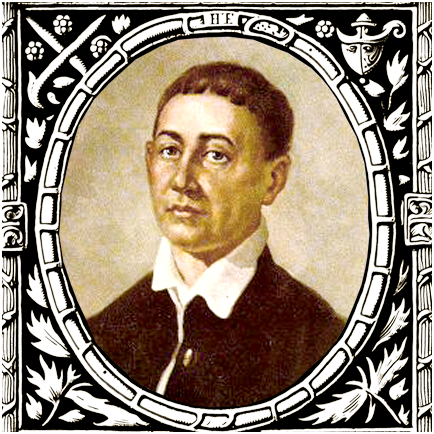
Hryhorii Savovych Skovoroda
1722-1794
The membership of Hryhorii Savovych Skovoroda (1722-1794) in Freemasonry - the eminent Ukrainian philosopher, mystic, poet, and musician, who was called the "Russian Socrates" - has not been established, but neither has it been refuted. In favor of the version of his belonging to the Order testify his works, imbued with the Masonic ideas of "building" - the perfecting of man and society, the search for a religion of "love and virtue," of the "light of the spirit."
Skovoroda asserted that the Bible is the most perfect and wisest source; it is an apothecary's shop, filled with Divine wisdom for the healing of inner peace, not cured by any earthly medicines.
Skovoroda (like the Freemasons) regarded as his teachers not only Pythagoras and Plato, but also the German mystics. In the spirit of the Rosicrucian pseudonyms, Skovoroda liked to call himself "Hryhorii Bar-Savva," that is, "Son of Rest." Skovoroda studied for almost 20 years at the Kyiv-Mohyla Academy, and was a chorister and choirmaster of the imperial chapel in Saint Petersburg (1741-1743). In 1745-1750 Skovoroda traveled through Europe as a translator of the mission of General F. Vyshnevsky: he visited Hungary, Poland, Germany, Italy, Austria (he may have become a Rosicrucian in Vienna).
Afterward he visited Moscow and for about six years was a tutor on the estate of the landowner Tomara, of Greek-Ukrainian-German origin, in the Poltava region.
In 1759 Skovoroda moved to Kharkiv to teach poetics at the local Collegium. But, having refused a high ecclesiastical rank and tonsure, he brought upon himself the wrath of the bishop and left the Collegium. Skovoroda also declined the invitation of the Kharkiv governor Shcherbinin to enter state service.
In 1768 Skovoroda resumed his teaching activity at the Kharkiv Collegium, but his course of lectures on theology aroused the displeasure of the Bishop of Belgorod. In 1769 Skovoroda left the Collegium and became a wandering philosopher. In many of the places where he was, circles of his followers arose - in Lyptsi, Husynka, Babai, Kharkiv, Belgorod…
Traveling through Left-Bank Ukraine, he would stay with his powerful landowner friends (Freemasons): Karazin in Kruchyk, Zakharzhevsky in Velykyi Burluk, the Kapnists in Velyka Obukhivka.
Skovoroda prepared a circle of enlightener-patrons who set themselves the goal of opening the first university in Ukraine. H. Danylevsky wrote that for the opening of Kharkiv University a large sum was given by the pupils and friends of H. Skovoroda.
The legacy of Skovoroda was honored and propagated in Masonic circles. His works were first published in 1798 and 1806 by the Freemasons M. Antonovsky and A. Lobzin.
His manuscript legacy was preserved thanks to the Freemason M. Kovalynsky ("The Life of Hryhorii Skovoroda" - a significant literary monument, which was part of the Masonic collection "The Mirror of the World"); one of the Masonic lodges was named after him.
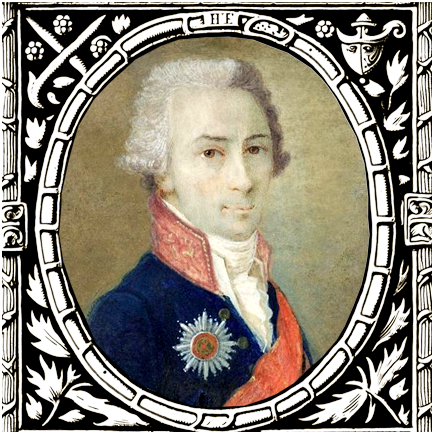
Mykhailo Ivanovych Kovalynsky
1745-1807
He was the tutor of the children of Kyrylo Rozumovsky, traveled abroad together with them, and studied at the University of Strasbourg.
Kovalynsky came from a family of Ukrainian Cossacks and received his first education at the Kharkiv Collegium and the Kyiv Academy; he became a pupil and friend of the philosopher Hryhorii Skovoroda, the author of works about the life of Skovoroda, the creator of the "Skovoroda myth" about the ideal philosopher (the Masonic ideal).
Until 1769 M. Kovalynsky taught at the Kharkiv Collegium, but then moved to Saint Petersburg, where he made a rapid career - he became prosecutor of the Military Collegium and governor of Riazan.
In 1801-03 he served as curator of Moscow University and initiated the "Masonization" of this educational institution; he was a member of the Free Assembly at Moscow University.
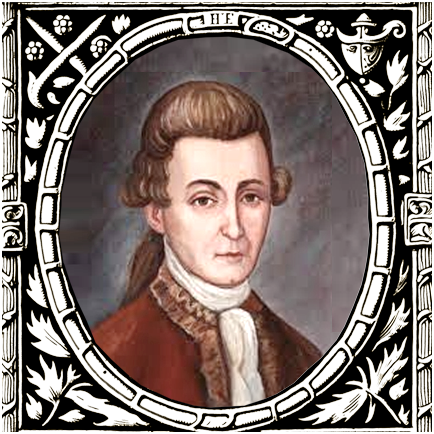
Nestor Maksymovych Maksymovych - Ambodyk
1744-1812
The founder of scientific obstetrics, a scholar-encyclopedist, botanist, the first phytotherapist, a renowned wit.
The son of a priest from the Poltava region, he formed his pseudonym "Ambodyk" from the Latin for "say twice." He graduated from the Kyiv Academy, in 1770-75 studied at the University of Strasbourg, where he defended his doctoral dissertation, after which he acquainted himself with the medical practice of Germany.
In Strasbourg he became a Freemason, and later received the 4th degree of Freemasonry. In 1781 he was appointed professor of the Saint Petersburg School of Obstetrics. He wrote the first textbook on pediatrics in the empire. In 1780-81 he was secretary of the Masonic lodge "Neptune."
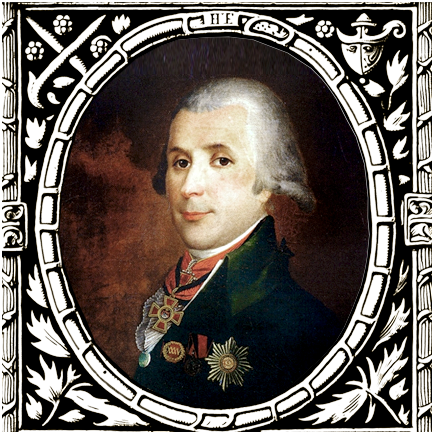
Anton Antonovych Antonsky-Prokopovych
1762-1848
A Ukrainian nobleman from Pryluky, he graduated from the Kyiv Academy and Moscow University, where he attended lectures at the philosophical and medical faculties, and became a Freemason at the beginning of the 1780s (by 1783 he already held the degree of Rosicrucian). In 1784, together with S. Hamaliia, he founded the university Lodge of the Rosicrucians "Hermes."
He obtained the post of teacher at the Noble Boarding School, where he taught natural history, and later became director of the university botanical garden; he was an ordinary professor, censor of the university printing house, a member of the Censorship Committee, secretary of the Society of Lovers of Russian Learning, and a member of the Academy of Sciences.
In 1803-18 he directed the chair of mineralogy, and in 1807-17 he served as vice-rector of Moscow University and dean of the physics and mathematics faculty.
In 1818-26 he was rector of Moscow University, and in 1819 he became the organizer of the Society of Agriculture.
As a writer, A. Antonsky-Prokopovych worked for the journals published by M. Novikov. In 1788-89 he was editor of the journal "Magazine of Natural History," and in 1791-93 of "Reading for Taste, Reason, and the Feelings."
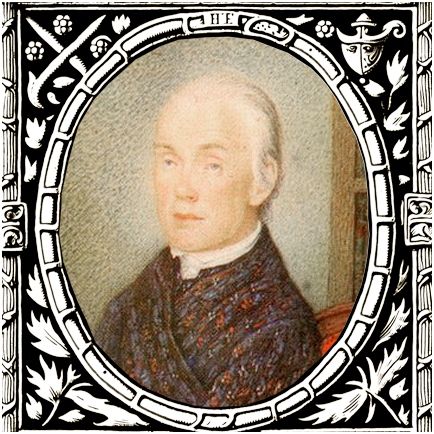
Semen Ivanovych Hamaliia
1743-1822
A philosopher-mystic from the Poltava region, a graduate of the Saint Petersburg Academy, a friend of M. Novikov. S. Hamaliia belonged to the Lodge "Harmony" and was the head of the Moscow Lodge "Deucalion."
His chief interest was the publication of hermetic texts and the translations of the philosopher Boehme. He led an ascetic life, spending his days in meditation and the reading of the Bible.
His contemporaries called him a "man of God." From 1784 he spiritually directed the Russian order of the Rosicrucians.
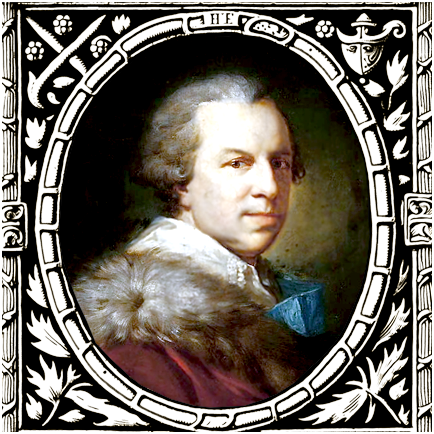
Stanislaw Szczesny-Potocki
1751-1805
A senator; he lived for a long time in Western Europe and became a Freemason already in his youth. With the name of the Grand Master of Freemasonry Stanislaw Szczesny-Potocki is connected the history of the creation of the unique park-and-palace complex "Sofiyivka" in the Uman region.
His contemporaries recounted that S. Potocki "…was a lover of the peasantry, of Ukrainian folklore, and of varenyky with sour cream."
S. Potocki strove to establish on his estates humane principles, the ideas of religious and national tolerance, and abolished serf labor. After his speeches in defense of the Volhynian peasantry, S. Potocki "lost his popularity" among the aristocrats.
The great magnates from Ukraine I. Potocki, S. Szczesny-Potocki, K. Liubomyrsky, and others promoted religious toleration and built or repaired about 300 Orthodox churches in Ukraine and Belarus.
Potocki was interested in the occult and numerology, and sought to realize his state project of creating a republic - the "Union of the Provinces of the Polish-Lithuanian Commonwealth," in which the Ukrainian lands would be granted the status of autonomy.
By order of Potocki, the Potocki palace and an enormous park were created in Tulchyn. After this, Potocki began the construction of the park-and-architectural ensemble "Sofiyivka."
The director and designer of the works was a Freemason, the Polish artillery captain L. Metzell.
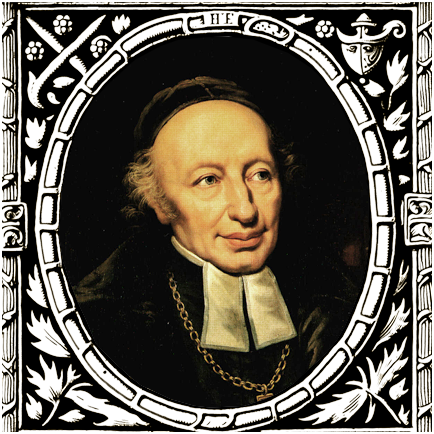
Ignaz (Innocent)-Aurelius Fessler
1756-1839
He was born in Hungary into a Catholic Alsatian family. Having left the Catholic Capuchin order and renounced the rank of Catholic priest, I.-A. Fessler became a Freemason in one of the Lodges of Vienna. He came to Lviv. Later he became a Freemason of the Lodge "Phoenix to the Round Table" of the Swedish system of the Strict Observance.
Fessler was invited to the post of professor of Oriental languages, hermeneutics, and theology at the University of Lviv, which was at that time about to open.
The Freemasons of Lviv remembered I.-A. Fessler as a "gigantic personality, who shines from afar, like a pillar of fire before the people of Israel." In Lviv, Fessler published the book "What the Masonic Lodges Are and What They Ought to Become," in which he set forth the ideas of "reformist" Freemasonry.
He saw the task of Freemasonry in the creation of a "new civic order" - the re-education of people for the coming age of Astraea.
The Freemasons believed that in the "post-historical" future, where time would be no more, in the eternal kingdom of Light and brotherhood a new paradise would come upon the earth - the golden age of Astraea; that in the "new golden age" there would be no power, no borders, and no dominion.
In Lviv he began to develop a new Masonic ritual, which was called the Fessler ritual or the Berlin ritual. In it there were three symbolic degrees (apprentice theosophist, journeyman theosophist, master theosophist) and six higher degrees (Holy of Holies, Defender, Glorified, Truly Enlightened, Patriot, Perfected).
Subsequently this ritual was for some time used in the Grand Lodge of Germany. Fessler wrote dozens of literary works, dialogues, and books on history. In 1788 the premiere of Fessler's play "Sidney" provoked not only a lawsuit against the author on the part of the Jesuits, but also the wrath of the Emperor of Austria, Joseph II.
Fessler was forced to leave the bounds of the Austrian Empire for Silesia, where he headed the para-Masonic "Union of Evergetes (benefactors)." Later, having settled in Prussia, Fessler created the mystical Order "Society of Friends of Humanity" - an Order of "scientific" Freemasons, and also became an honorary member of the Berlin Lodge "Royal York to Friendship."
In 1796-1802 he was elected Master of the Chair of this Lodge. At that same time Fessler drew close to the philosopher Fichte and engaged him in the work of reforming the Masonic movement. When in 1802 a schism took shape in the Lodge "Royal York to Friendship," Fessler left it. In December 1809 Fessler came to the Russian Empire, where at the initiative of the Freemason M. Speransky he converted to Lutheranism. He was invited to deliver lectures on the Hebrew language, Biblical exegesis, and philosophy at the Orthodox Saint Petersburg Theological Academy.
I.-A. Fessler became the "founding father" of Christian Neoplatonism in the Russian Empire, a propagandist of a single religion, at the center of which God appeared as the first idea and the first substance. He taught the students that "worship consists of two elements: the lyrical and the dramatic." However, such ideas provoked the protests of the Orthodox orthodox, and after seven months of teaching Fessler was dismissed from the Academy. Already while working at the University of Lviv, Fessler had selected capable students for further Masonic devotion and missionary work.
He brought up a galaxy of Masonic enlighteners from among Austrian subjects: from the Transcarpathian Ukrainians - I. Orlai, P. Lodii, V. Kukolnyk, M. Baludiansky. All these pupils of Fessler left the Austrian Empire and settled in the Russian, where they made loud names for themselves in the field of science and education.
From 1809 I.-A. Fessler was an honorary member of the Masonic Lodges: "United Friends," "Peter to Truth," "Alexander the Beneficent to the Crowned Pelican," and the Grand Lodge "Astraea"; he founded in Saint Petersburg his own Lodge "Polar Star," which was joined by M. Baludiansky, V. Kukolnyk, P. Lodii, I. Orlai, M. Speransky. Fessler's Lodge of "countrymen" was transformed into a circle of enlighteners whose aim was the "emancipation of Russian society."
M. Speransky, together with Fessler and Baludiansky, drew up a memorandum addressed to Emperor Alexander I, in which they substantiated the possibility of carrying out radical reforms with the help of Freemasonry.
After his expulsion from the Orthodox Academy, Fessler obtained the post of official (and then head) in the Commission for the Drafting of the Laws of the empire. In 1812 Fessler was exiled from the capital to the Saratov Governorate, where he became president of the Lutheran consistory of the German colonies of the Volga region and general superintendent.
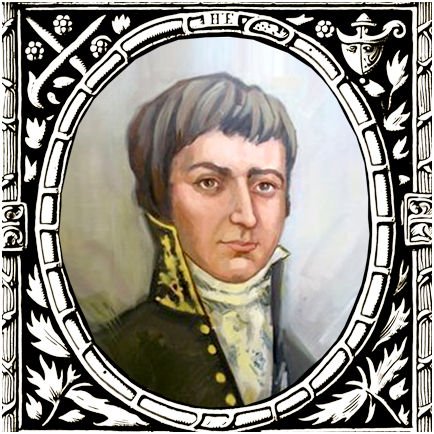
Ivan Orlai
1771-1829
He studied at the Velyka Karlivka Gymnasium of Higher Sciences, at the Velyki Varadyn Academy, and at the universities of Pest and Lviv. In 1790 he became professor of ancient languages at the Velyka Karlivka Gymnasium of Higher Sciences, and already in 1791 he moved to Saint Petersburg.Having obtained a position at the chair of the Saint Petersburg Pedagogical Institute, I. Orlai became acquainted with M. Speransky and under his influence abandoned an ecclesiastical career. He studied at the Saint Petersburg Medical-Chemical Academy and at the University of Vienna, and received the title of physician.
I. Orlai, who had been admitted into Freemasonry while he was still in the Austrian Empire, worked in Saint Petersburg in the Lodges "United Friends" (of the system of Fessler) and "Alexander of the Golden Lion," which was intended for the higher degrees of Freemasonry.
Ivan Orlai worked in the General Land Hospital of Saint Petersburg, as assistant to the learned secretary of the Medical Collegium. In 1794-97 he was in Vienna on a mission for the "perfecting of knowledge."
Having returned to the Russian Empire, in 1798-1821 he served as court physician and court surgeon of His Imperial Majesty, secretary of the Medical-Surgical Academy, and resident of the Saint Petersburg Land and General Hospitals. In 1804 Orlai published the "History of the Carpatho-Russians," and in 1806 he defended a dissertation, received at the University of Königsberg the title of doctor of philosophy, and in Dorpat the title of doctor of medicine.
Later he became editor of the "General Journal of Medical Science." He was a member of the Society of Naturalists and the Society of History and Antiquities. In 1803 a project of I. Orlai was drawn up "On the Summoning to Russia of Foreign Scholars, People of the Slavic Tribe, and most of all of the Carpatho-Russians, who have received the title of professors in Austria and are capable of teaching in the Russian language."
This project was approved, and Orlai was sent to Galicia and Transcarpathia in order to invite talented scholars who knew the foundations of the Slavic languages to the vacant places at the chairs. Then the Freemason-professors M. Baludiansky, V. Kukolnyk, P. Lodii, A. Dudrovych moved to the Russian Empire…
In 1821-26 Orlai was director of the Nizhyn Lyceum of Prince Bezborodko. In the first half of the 19th century the small Ukrainian town of Nizhyn became one of the prominent cultural centers of Ukraine.
In 1820 a gymnasium (lyceum) of higher sciences named after Prince Bezborodko was opened here. The Freemasons sought to create in Nizhyn a second "lamp of enlightenment" in Left-Bank Ukraine. In September 1821 Ivan Orlai was appointed director of the Nizhyn Lyceum of Prince Bezborodko. He worked in this post until August 1826.
About the "Nizhyn period" of Orlai's life it is known that he sought to introduce the methods of the pedagogue Pestalozzi. By its statute, the Nizhyn Gymnasium (lyceum) was equated with a university (the gymnasium was attended by M. Gogol, Ye. Hrebinka, N. Kukolnyk). In selecting pedagogues for the lyceum, I. Orlai invited to Nizhyn the Masonic brethren of the Lodge "United Slavs."
In 1826 he was promoted to actual state councilor and transferred to the post of director of the Odesa Richelieu Lyceum (he remained in this post until his death in February 1829).
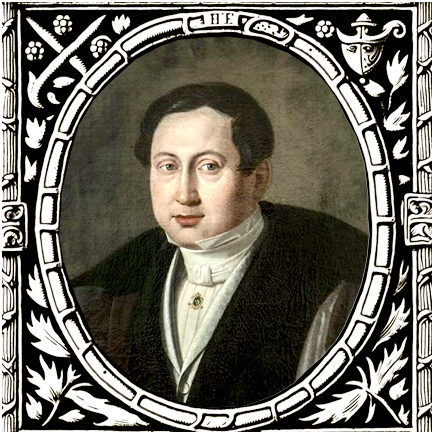
Petro Lodii
1764-1829
A philosopher and jurist, he graduated from the philosophical faculty of the University of Lviv and worked as professor of philosophy at the universities of Lviv and Kraków.After the founding of the Pedagogical Institute in Saint Petersburg (1803), he was invited to the chair of natural law, logic, metaphysics, and moral philosophy.P. Lodii wrote books, among them "Logical Precepts Leading to the Knowledge and Distinguishing of the True from the False" and "The Theory of General Rights."
A convinced republican, P. Lodii emphasized that civic liberty is "by understanding the self-willed determination of oneself in activity." The concept of equality he interpreted as the equality of all people before the law.
From 1819 Petro Lodii worked as professor at the philosophical-juridical faculty of Saint Petersburg University, and belonged to the Lodges "Peter to Truth" and "Alexander of the Threefold Salvation."
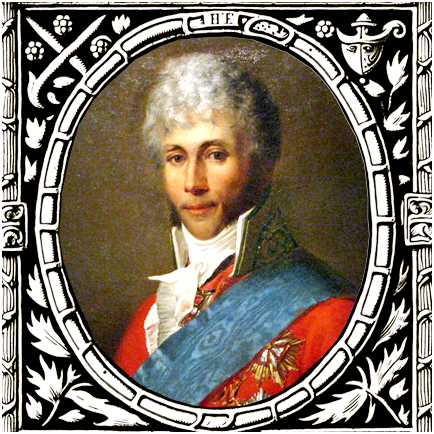
Severyn Osypovych Potocki
1762- 1829
Count, trustee of the Kharkiv Educational District and University. Initiated into Freemasonry at the age of 19, S. Potocki received his education at the universities of Geneva and Lausanne. He was among the chosen "friends" of the future Emperor Alexander I, enjoying his particular trust.A Masonic leader, actual privy councilor, senator, the first trustee of the Kharkiv Educational District.
In 1803 S. Potocki turned in Weimar to the local minister, poet, and Freemason of the higher degrees Johann Wolfgang Goethe with a request to help in forming the teaching staff of the university.
J.-W. Goethe fulfilled the request. On his recommendation, professors from Würzburg, Wittenberg, Leipzig, Göttingen, and Frankfurt were invited to Kharkiv. These were specialists in the field of philosophy, psychology, medicine, and veterinary science.
Of S. Potocki it was said that he was a man "honest and noble, of excellent mind and education," "pleasant and witty." In the last years of his life he acquired the estate of Severynivka 60 km from Odesa, maintained a correspondence with Goethe, and was one of the founders of the Society of Agriculture (1828, Odesa).
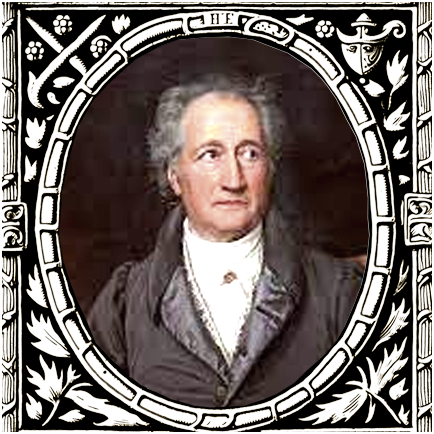
Johann-Baptist Schad
1758-1831
An eminent philosopher, docent of the University of Jena.On the recommendation of the Freemasons Goethe and Fichte (Schad worked as Fichte's deputy at the chair), Schad was invited to Kharkiv University, where he worked in 1804-16. In Kharkiv J.-B. Schad received the rank of court councilor and an ordinary professorship, and was elected dean of the faculty, secretary of the university council, and a member of the school committee.
The books of J.-B. Schad "The Life of Father Sincerus" and "Natural Law," and his satire on the Catholic clergy were declared harmful and "dangerous to Russian youth."
The Cabinet of Ministers adopted a circular by which it was prescribed to expel J.-B. Schad beyond the bounds of the empire.
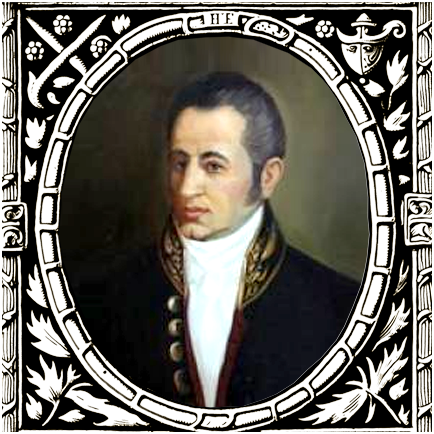
Andrii Ivanovych Dudrovych
1796-1859
He began his studies at the gymnasium in Košice (Czechia) and continued them in Ofen (Hungary). In 1799 he entered the University of Pest, and continued his education at the Academy of Košice, where for a year he studied Hungarian law.In 1806 he moved to Ukraine, taught history, technology, and commerce at the Chernihiv Gymnasium, and then - those same subjects and the Latin language at the Kharkiv Gymnasium.
A professor of Kharkiv University, a Freemason - an adherent of the mystical direction, a pupil of Schad, an expert in the newest philosophical systems of Kant, Fichte, and Schelling.
From 1812 he taught pure logic at Kharkiv University, where in 1814 he defended a dissertation for the degree of doctor of philosophy and was elected adjunct of the chair of philosophy. He taught courses in logic, theoretical and practical psychology, history, philosophy, ethics, and law.
In 1819 he received the title of ordinary professor and taught courses in pure logic, theoretical and practical psychology, history, philosophy, ethics, and natural law; he published in the "Ukrainian Herald" (the article of spiritualist content "On Animal Magnetism").
A. Dudrovych devoted his works to the elaboration of the problem of the state and law, of the liberty of the individual; he advocated the liberation of enslaved peoples and was the organizer and head of the student Bible Society. In 1829-30 A. Dudrovych was rector of Kharkiv University.
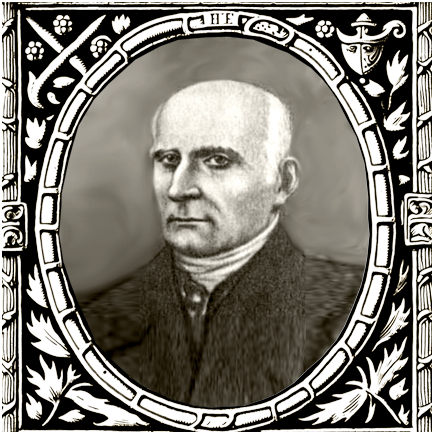
Pavlo Mykhailovych Shumliansky
1750-1824
He studied at the Kyiv Academy (the philosophical classes) and studied medicine abroad. In 1789 he defended a dissertation for the degree of doctor of medicine at the University of Strasbourg, where he became friends with a Ukrainian student and Freemason, D. Samoilovych.Having returned in 1790 to the empire already a master Freemason, P. Shumliansky worked as a physician at the Saint Petersburg Military Hospital, as professor of pharmacology and surgery at the Kronstadt College, and as professor of surgery at the Moscow Medical-Surgical Academy.
At Kharkiv University, Professor P. Shumliansky worked in 1805-17, having headed the Chair of Surgery. He was repeatedly elected dean of the medical faculty, created a faculty surgical clinic, and discovered the healing properties of the mineral waters of the Poltava region.
His contemporaries remembered P. Shumliansky as a wise elder, a jester, and a wit, who was the first in the Ukrainian universities to attempt to deliver lectures in the Ukrainian language.
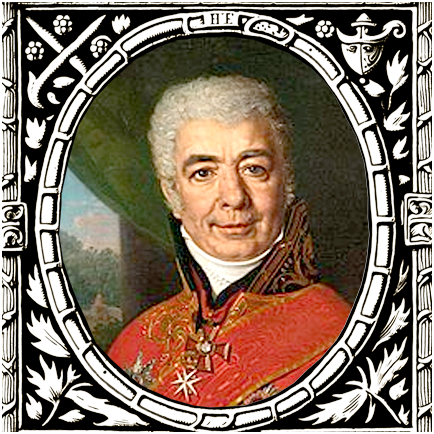
Zakhar Yakovych Karneiev (Korneiev)
1748-1828
He came from the Sloboda Cossacks. In 1808 he became a senator, and in 1810 a member of the State Council. He was included in the Commission for the Drafting of the Laws of the empire; he was vice-president of the Bible Society, an honorary member of the Free Society of Lovers of Literature and of the Society of Naturalists.In 1817-22 Z. Karneiev was trustee of the Kharkiv Educational District and of Kharkiv University.
A Freemason of the "Novikov" school - a "Master Theoreticus," a follower of Boehme, Robert Fludd, Jan Comenius, and Saint-Martin.
To him are attributed works published with the initials K.Z.: "Thoughts that Poured Forth During the Reading of the Lord's Prayer 'Our Father,'" "My Conceptions of the Symbol of Faith." He developed a special manuscript compendium for his colleagues, which contained extracts from various alchemical works and a cosmogenesis.
Z. Korneiev intensified Masonic activity in Kharkiv, created with the participation of university students secret mystical "fellowships," similar to the Rosicrucian unions, and actively promoted the ideas of the Bible Society among the youth.
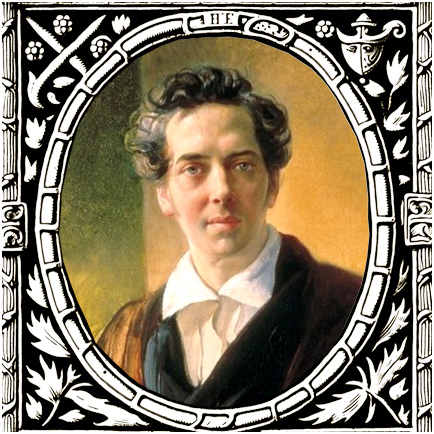
Oleksii Oleksiiovych Perovsky
1787-1836
The illegitimate son of Oleksii Rozumovsky, staff captain of the 3rd Ukrainian Regiment (1812-13), and later a renowned writer-mystic.He was a representative of the Ukrainian anti-imperial cultural movement, and lived for a long time on his estate of Krasnyi Rih - Pohoriltsi near Pochep, in the Starodub region. He received the degree of doctor of philosophy and letters. The author of the novellas "The Double, or My Evenings in Little Russia," "Isidor and Aniuta."
From 1822 he was trustee of the Kharkiv Educational District and University, a member of the Society of Sciences at Kharkiv University.
To the Kharkiv Lodge "The Dying Sphinx" of the "second period" (1817-22) belonged 25-30 brethren. Among them were the writers A. Pohorilsky, M. S. Vlasov, and P. Hulak-Artemovsky, A. Dudrovych.
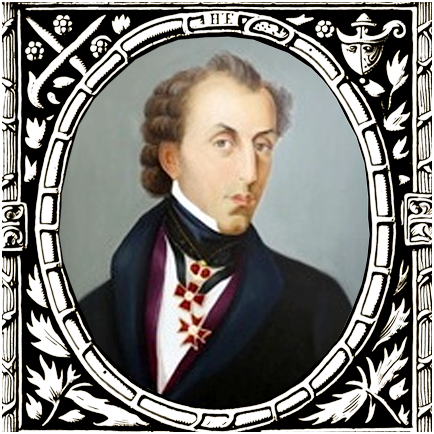
Petro Petrovych Hulak-Artemovsky
1790-1865
A Ukrainian writer. He began his education at the Kyiv Seminary and the Kyiv Theological Academy, but did not complete the latter. In 1817 he moved to Kharkiv and entered the university as a free auditor of the faculty of letters.Thanks to the patronage of the trustee of the Kharkiv Educational District, the Freemason S. Potocki, he was confirmed by the University Council as lecturer of the Polish language, and from 1820 as a teacher of history, geography, and statistics.
In 1821 he defended a dissertation, and two years later was elected adjunct of Russian history and statistics, and in 1828 an ordinary professor. P. Hulak-Artemovsky was one of the leaders of the secret Masonic Lodge in the 1830s.
In 1841-49 he was rector of Kharkiv University (from 1855 an honorary member of Kharkiv University). From 1817 he began to publish in the Kharkiv journal "Ukrainian Herald" translations, fables, and romantic ballads.
He became one of the founders of the "Ukrainian Journal." He was a member of the Moscow Society of Amateurs of Russian Letters and of the Royal Society of Friends of Science in Warsaw.
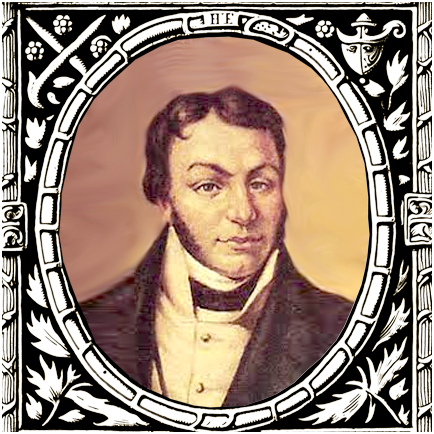
Hryhorii Fedorovych Kvitka-Osnovianenko
1778-1843
"Suspected" of Martinism - one of the editors of the journal "Ukrainian Herald," a classic of Ukrainian literature, and later the Marshal of the Kharkiv nobility and the Chairman of the Chamber of the Criminal Court.It is known that in his young years H. Kvitka-Osnovianenko was such a religiously exalted youth that he spent four years in a monastery.
The opening of Kharkiv University brought a significant enlivenment to the life of local society, and Kvitka-Osnovianenko yielded to the "temptation" of education.
He became absorbed in public activity, literature, journalism, and the theater (as a spectator, actor, and dramatist). At the initiative of H. Kvitka, a Charitable Society arose in Kharkiv, and a women's educational institution was founded, in which those willing of any social standing could study.
In the 1820s-30s he wrote a number of plays: "The Visitor from the Capital, or the Commotion in a District Town," the trilogy about Shelmenko, "The Matchmaking at Honcharivka," "The Bold Woman." He wrote and published a whole series of prose works: "Mr. Khaliavsky," "The History of the Theater in Kharkiv," "The Konotop Witch," "Marusia," and so on.
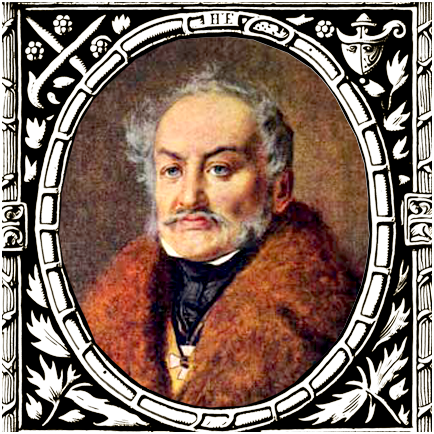
Vasyl Lukych Lukashevych
1783-1866
He belonged both to the Kyiv Lodge "United Slavs" and to the "Union of the Templars of Volhynia," and was the head of the "Little Russian Secret Society," a court councilor.In 1809-26 he was Marshal of the Nobility of the Pereiaslav District. In the course of the investigation of the Decembrists it came to light that V. Lukashevych had founded a secret Ukrainian society connected with the "Polish conspirators."
In the Ukrainian society there was a "catechism after the manner of the one used in the Masonic Lodges" (the Catechism of the Autonomist), and this society "…dreamed of the independence of Little Russia."
It is strange that the investigative commission decided not to punish Lukashevych, but came to the conclusion that he and his like-minded associates only "…had the intention of creating from the Masonic Lodges" a political society, but never created it.
Therefore Lukashevych was released from arrest and sent into "exile" - to his estate in Boryspil near Kyiv. But, most likely, the investigation deliberately erred (perhaps because Lukashevych was a Masonic honorary magister?), and V. Lukashevych did after all create the Little Russian Secret Society back in 1819. He founded a school in Pereiaslav.
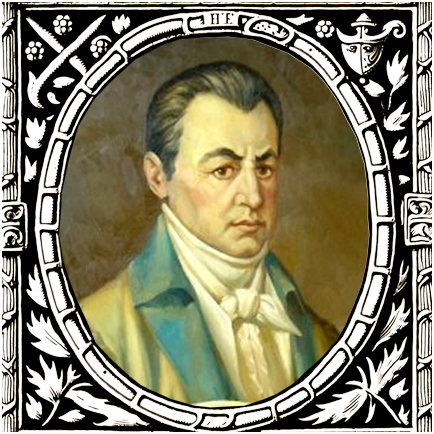
Ivan Petrovych Kotliarevsky
1769-1838
A Ukrainian writer, military officer, classic of Ukrainian literature, and public figure. His poem "The Aeneid" (1798) became a great work of nationwide significance for the new Ukrainian literature. He made the most weighty contribution to the formation of the modern Ukrainian literary language. Amid the decline of all varieties of the Old Ukrainian written language, the poem "The Aeneid" and the plays "Natalka Poltavka" and "The Muscovite Sorcerer" inaugurated a new stage in the formation of the literary language.
He was the orator (the "vitiia") of the Poltava Masonic Lodge, a member of the Poltava branch of the Bible Society. The nobleman I. Kotliarevsky possessed two families of serfs, whom he set free as early as 1808. When he retired with the rank of captain, he worked as supervisor of the Poltava House for the Upbringing of Poor Nobles.
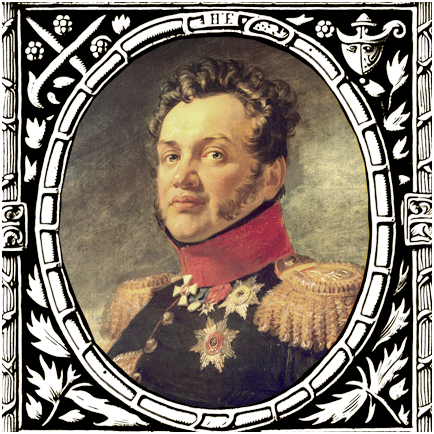
Mykola Hryhorovych Repnin-Volkonsky
1778-1845
He began his service in the Chevalier Guard Regiment and was sent with the retinue of his grandfather, Prince Repnin, to Prussia for the coronation of King Frederick William III (a Rosicrucian Freemason) in 1798. In 1799 he took part in the military operations in the corps of General Hermann, which acted in Holland against the French, then sailed on an English frigate, and served as envoy to the King of Westphalia, Jérôme. During the campaign of 1812-14, adjutant general M. Repnin-Volkonsky commanded the forces that took Berlin.
He took part in the battles near Dresden, Kulm, and Leipzig, and performed the duties of governor general of the Kingdom of Saxony.
In 1814 M. Repnin was appointed military governor of Little Russia and served in this post for 20 years (Poltava being the center of the governor-generalship). In fact he headed the Masonic Order in the Poltava region.
His contemporaries believed that M. Repnin loved the history and culture of Ukraine and helped the figures of Ukrainian culture; he was suspected of "Ukrainophilism" and "separatism," with whispers about him as a "revolutionary" and "a second Mazepa." The wife of Mykola Hryhorovych was the daughter of Count Oleksii Kyrylovych Rozumovsky (a hereditary Rosicrucian Freemason).
After his retirement M. Repnin lived in Dresden, Rome, and Florence, and in his old age settled on his estate in the Poltava Governorate.
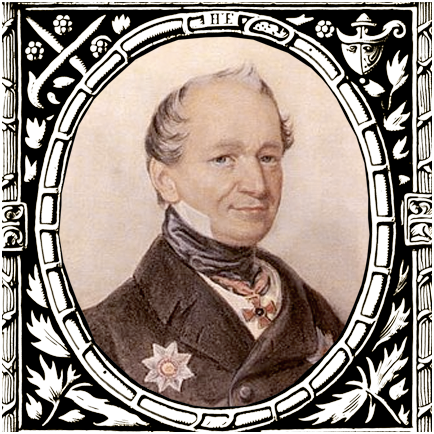
Dmytro Mykolaiovych Bantysh-Kamensky
1788-1850
He belonged to the aristocratic family of the Moldavian princes and was the grandson of the poet Prince Antiochus Cantemir.The author of the famous "History of Little Russia." In 1814-15, as an official of the Collegium of Foreign Affairs, he lived in Paris. After which he was for a long time the head of the chancellery of the governor of Little Russia, and was an "activist" of the Bible Society.
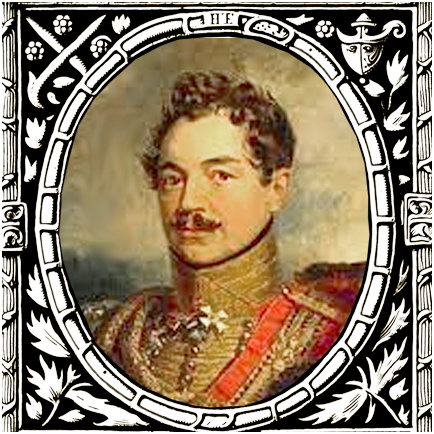
Gustaw-Henryk-Atanazy-Narcyz Olizar
1798-1868
An aristocrat born in the Kyiv Governorate, a renowned Polish poet, a member of the Polish "Patriotic Society" and of numerous Masonic lodges, a count.He was the Orator, and then the Master of the Chair, in the Lodge "United Slavs." As the Kyiv Provincial Marshal, Olizar called upon the nobility of the Kyiv Governorate to free the serfs and to enroll them among the state peasants.
From 1826, after the Decembrist uprising, the Investigative Committee placed the name of Gustaw Olizar on the list of persons who were to be immediately arrested and brought under guard to Saint Petersburg.
However, after the arrest of Olizar, the new emperor signed an order for his release. Olizar was "deported" to the Kyiv Governorate under police surveillance. In November 1830, during the Polish uprising, Olizar was again arrested.
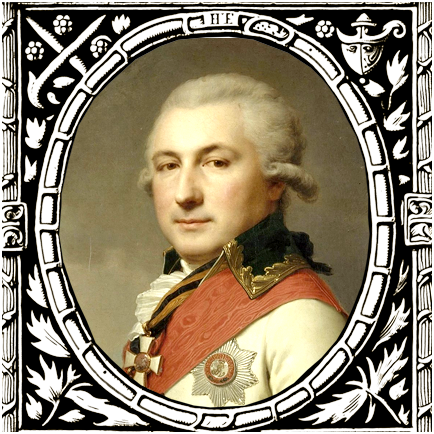
José (Yosyp Mykhailovych) de Ribas
1751-1800
The "discoverer" and "father" was born in the Italian city of Naples in 1749 into the family of a Spanish nobleman, a general of the army of the Kingdom of the Two Sicilies, Michele de Ribas, who was married to an Irishwoman of the family of the Lords Duncan.From the age of 22 de Ribas served the Russian Empire: he fought in the naval battle in the Bay of Chesma during the Russo-Turkish war. At the beginning of the 1790s de Ribas became a participant in all the battles of the Ochakiv military campaign, the conquest of Khadzhibei and Akkerman, and the taking of Izmail.
He commanded the Danube flotilla and the rowing Black Sea fleet, and the construction of Khadzhibei as the principal base of the rowing military fleet. In 1794 the vice admiral of the Russian military fleet de Ribas became one of the chief initiators of the founding of the city of Odesa.
He governed this city for about three years, and was then recalled to Saint Petersburg. De Ribas became a Freemason in Naples, and later entered the Saint Petersburg Masonic organization "French Lodge," and the Saint Petersburg Lodge "Beneficence to the Pelican."
In Saint Petersburg toward the end he became a member of the Lodge "Chapter of the Phoenix" (for Freemasons of the higher ranks), which gathered under conditions of the strictest secrecy and governed Masonic activity.
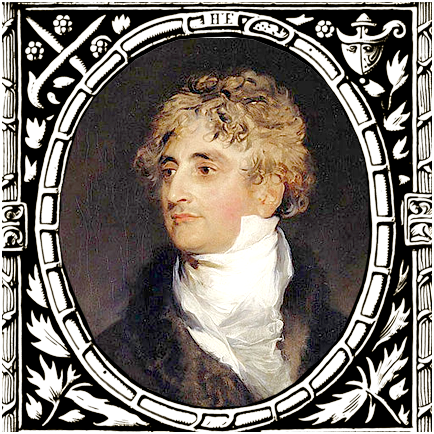
Armand Emmanuel du Plessis Richelieu
1766-1822
Count de Chinon, Duke de Fronsac - the great-great-nephew of Cardinal Richelieu (the minister of the French king Louis XIII) and the grandson of a Marshal of France; in 1786 de Richelieu became a member of the Paris Masonic Lodge "Olympic Society." Then followed a Masonic career in two more Lodges and the post of orator in one of the Paris Lodges (already by then de Richelieu had become a Master).
Among the Masonic teachers of de Richelieu was de Langeron (initiated into the Masonic Lodge "Olympic Society" in 1782) and the writer, Prince de Ligne. De Ligne was one of the first French Freemasons to visit the Ukrainian steppes in 1787, and took part in the siege of Ochakiv.
De Ligne, de Langeron, and de Richelieu set off to seek their fortune in the Russian army, which was stationed in Bessarabia. All three were admitted into the Danube rowing flotilla under the command of de Ribas and took part in the Second Russo-Turkish war, in which de Richelieu received the rank of colonel. De Richelieu was seized by the idea of creating in the southwest of the Russian Empire a colony-city, "New France."
On January 27, 1803, he became the city governor of Odesa (which then had 8,000 inhabitants). In Odesa de Richelieu "ruled" without restraint. In 1803-14 he opposed excessive state tutelage over the city on the part of the bureaucratic apparatus, secured the lifting of the tax burden from Odesa, the right of "free transit," and sought to develop the self-organization of society.
The emperor granted de Richelieu the right to decide questions that exceeded the powers of the city governor and to turn directly to the emperor for the resolution of local questions (bypassing the departmental institutions).
Odesa was "informally" set apart from the general command-administrative system of the empire and became a "state within a state." During the reign of de Richelieu in Odesa, hundreds of stone houses, a cathedral, a theater, a market, an educational institute, a commercial gymnasium, six lower educational institutions, two hospitals were built, and gardens were laid out. He practically created Odesa!
In his memoirs de Richelieu would write: "Odesa and Novorossiya made such progress in the shortest of terms as no state of the world has before them." Was de Richelieu perhaps planning to create not only an ideal city of Odesa, but also an ideal state "to suit him"? From 1805 de Richelieu became also the Kherson military governor and the head of the Yekaterinoslav and Tauride Governorates.
Under his authority fell vast territories on which new socio-economic relations were being inaugurated. It was de Richelieu who cultivated in Odesa the mass planting of the "Masonic" tree - the acacia. The Masonic "demonstrative" contempt for death was manifested especially in de Richelieu during the terrible epidemic of plague in Odesa, when he personally entered the plague-stricken houses and comforted the dying.
And when the workers refused to bury the plague-stricken corpses, de Richelieu himself took up a spade and dug graves for the wretched. He was regarded as an adherent of progress, of religious freedom, of the reform of Christianity, of political tolerance, of the liberal ideas of the economist Adam Smith, and as an admirer of literature and the art of the park. During the reign of de Richelieu, a secret Masonic Lodge operated in Odesa, which he may possibly have headed.
There is a supposition that the Lodge included Count Petro Rozumovsky, Félix de Ribas (the brother of the founder of Odesa), Louis-Victor-Léon Rochechouart (a relative of Richelieu and his adjutant), Joseph d'Ollon - the nephew of Richelieu and the adjutant of de Richelieu, Ivan Oleksiiovych Stempkovsky, Charles Sicard, Baron Reno (the owner of the "Wondrous House" with Masonic symbolism), Colonel Thomas Cobley. After the victory of the forces of the coalition over Napoleon, de Richelieu decided to return to France.
In September 1814 he left Odesa, entrusting the Odesa city governorship to the commandant of the city, the Freemason, major general Cobley (who performed the duties of city governor of Odesa until December 1815).
In France de Richelieu found himself in the closest retinue of the new king and became a peer of France. In 1815-18 de Richelieu was prime minister and minister of foreign affairs of France, and in 1820-21 he became prime minister for the second time.
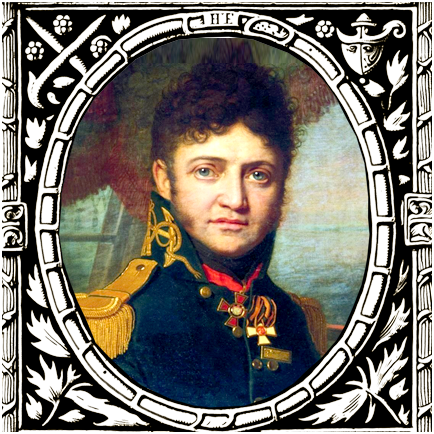
Stepan Mykhailovych Telesnytsky
1798-1868
A member of the Masonic Lodge "Neptune" with 15 years of standing, he founded a "branch" of "Neptune" in Odesa, in the circle of naval officers and officers of the port and the customs house.It is known that he came to Odesa in 1801 with Masonic commissions and "the necessary acts for the works" for the creation of a Lodge. Telesnytsky graduated from the Naval Corps in the 1780s, and sailed the seas and oceans first as a midshipman, then as a lieutenant. In 1788 he was awarded the master's degree of Freemasonry.
The most romantic period of the life of S. Telesnytsky was the "pirate" one. In 1788-92 Telesnytsky recruited a crew in Malta and bought a corsair frigate that sailed the waters of the Mediterranean Sea. From 1792 Telesnytsky settled in Kherson, where he received the rank of captain-lieutenant. Later he took part in the expeditions of Admiral Ushakov to the Greek Archipelago with the aim of creating the Republic of the Seven Ionian Islands.
From 1801 Telesnytsky served in the port of Odesa, where he rose to the rank of captain of the first rank. In 1814 he became a state councilor and vice-inspector of the port quarantine of Odesa.
Telesnytsky was the director of the Odesa branch of the Bible Society, and conducted the "Masonic works" of a secret Lodge in his home in the area of Catherine Square in Odesa.
When in the middle of the 19th century this house was demolished, in the tightly sealed semi-basement were found elements of a Masonic Temple and a wall mural of mystical-symbolic content.
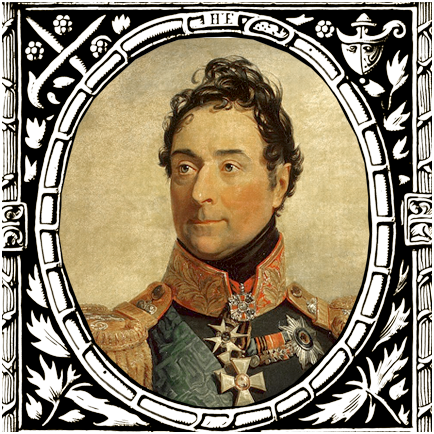
Louis-Alexandre-André (Oleksandr Fedorovych) Count de Langeron
1763-1831
Marquis de la Cosse, Baron de Cougny (a marquis and count of France, a baron of the Austrian Empire, until 1799 a citizen of the Canton of Geneva, from 1799 a subject of the Russian Empire) was born on January 13, 1763, in Paris.At the age of fifteen Langeron became a lieutenant of the French guard.
By 1789 de Langeron had received the 5th degree of Freemasonry - "Perfect Master" of the Lodge "United Friends," and became the Worshipful Master (Master of the Chair) of a Masonic Lodge. De Langeron received the French Revolution of 1789 with enthusiasm, but already a few months after the storming of the Bastille he became disillusioned with it.
The arrival of de Langeron in Russia in 1790 brought him under the walls of Izmail. For his bravery during the storming of the city he received a golden sword. In 1791 he served under the command of the Freemason Prince M. Repnin - the commander of the Russian forces in Moldavia.
Then came service in the ranks of the army of French volunteers in the Netherlands, in the army of the Prince de Condé, and in the Austrian army. In 1794 he took command of the Little Russian Regiment of grenadiers.
De Langeron took part in the military expedition to Corfu and quickly became a lieutenant general, but at the end of 1805 he submitted a report of resignation. He went to Odesa, seeking the support of his friend de Richelieu.
The resignation of de Langeron was not accepted by the emperor. From 1806 he was again in the army - he fought against the Turkish army on the Danube, and for several months served as commander-in-chief of the Russian Moldavian army. From 1812 de Langeron, as a corps commander, fought against Napoleon, and in 1813 his Russian "expeditionary" corps was part of the army of Blücher and of the Northern Army of the King of Sweden, Bernadotte.
The units of de Langeron were the first to burst into Paris and to seize the Montmartre batteries of the French forces. In November 1815 he was appointed city governor of Odesa (he held this post in 1815-20) and Kherson military governor (he held this post in 1815-23).
De Richelieu offered de Langeron the "Odesa career" and recommended to the emperor precisely this candidate as his successor. During the period of his activity in the post of city governor, de Langeron founded in Odesa a system of "free trade" - the porto franco, created the Odesa Botanical Garden, laid out the Primorsky Boulevard, initiated the appearance of the first local city newspaper, the "Messager de la Russie méridionale," and opened a public women's school and the Richelieu Lyceum.
De Langeron was regarded among his comrades as a great connoisseur of the arts, an original interlocutor, a wit, and the "soul of the company." Already at the end of the 1780s de Langeron wrote for the local French newspapers, published the satirical journal "The Acts of the Apostles," and occupied himself with literature (he wrote four plays and one comedy).
Among the known reformist projects of Langeron were proposals for constitutional reforms, the simplification of clerical correspondence and bureaucratic red tape, and the abolition of the Table of Ranks.
In 1722 Langeron again asked to resign. He went to France and remained there until he received word of the death of the emperor. In July 1828 all the Russian forces that were fighting against the Turkish army in Moldavia and Wallachia were placed under the command of General de Langeron.
Afterward he submitted his resignation and from the spring of 1829 settled in his beloved Odesa as a private person. The flourishing of the Masonic movement in Odesa, and the strengthening of the influence of Freemasonry on the life of the city, fell in the period of 1817-22 (the period of de Langeron).
The Freemasons sought to make of Odesa a model of the "city of the future." In 1817-22 the Masonic Lodges "Friends of Nature - The Three Kingdoms of Nature," "Pontus Euxinus," and "The Lodge of French and Italian Literature" operated in Odesa. The Lodge "Pontus Euxinus" ("du Pont Euxin") was one of the Masonic Lodges of the Scottish Rite of the Ninth Grand Masonic Province. The Worshipful Master (head) of the Lodge "Pontus Euxinus" became de Langeron, who was also a member of several Saint Petersburg Lodges and of the Feodosia Lodge "Jordan."
The Lodge of the higher degrees of Scottish Freemasonry, "The Three Kingdoms of Nature," began to be created in Odesa in 1815. This Lodge was also led by the Freemason of 25 years' standing, de Langeron. The attacks on the Odesa Lodge "Pontus Euxinus" for its "political dangerousness" on the part of the conservative entourage of the emperor began in the first half of 1822. Count Kiselev, in a letter to Count de Langeron, accused the "Brethren" of the Odesa lodge of a suspicious and dangerous "interest in politics." In October 1822 the Lodge was closed.
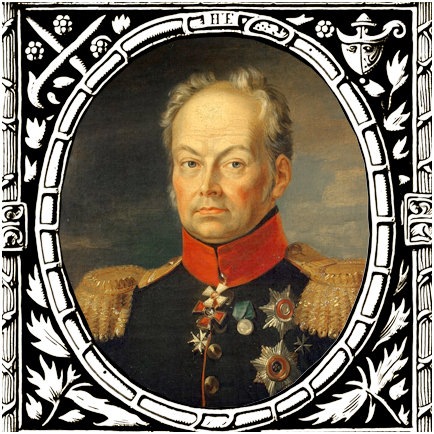
Ivan Mykytovych Inzov
1769-1845
He was the illegitimate son of some secret "high personage from the metropolitan 'world.'" He never saw his parents, but was brought up in the house of the Freemason Prince M. Trubetskoy.A surname was invented for him with a meaning: encoded in it was the phrase "another call" ("inzov").In his youth he drew close to the circle of the Masonic enlightener M. Novikov, who initiated I. Inzov into Freemasonry.
Besides the Moscow Rosicrucian Lodges, he also belonged to the German Lodge "The Golden Sphere." From 1789-90 lieutenant Inzov took part in the war against Turkey, in the sieges of Izmail and Bender. In 1798 lieutenant colonel Inzov was appointed commander of a regiment, with which he soon set off on a campaign to Italy.
In the twentieth year of his service, I. Inzov became a major general. In 1806-14 he fought against the Turkish forces on the Danube and against the Napoleonic forces, and was distinguished with the rank of lieutenant general.
In 1818 his appointment took place as chief trustee of the foreign colonists of the South of Russia, and in 1820 as governor of the Bessarabian region (governor general of the Bessarabian Governorate).
I. Inzov directed the activity of the Bible Society in Chișinău and the creation there of the Masonic Lodge "Ovid." In 1822-23 he was administrator of the Novorossiya region (during the foreign leave of de Langeron); at this time and in 1833-1845 I. Inzov lived in Odesa.
His contemporaries emphasized the erudition, honesty, and humaneness of the general. The patronage of Inzov over the Balkan settlers made him a "holy righteous one" in the eyes of the Bulgarians of Budjak. Under his "trusteeship," as a center of the Bulgarians, the city of Bolhrad took shape. After the death of the general, the Bulgarians asked permission to bury the remains of I. Inzov in Bolhrad and erected a Mausoleum over his grave.
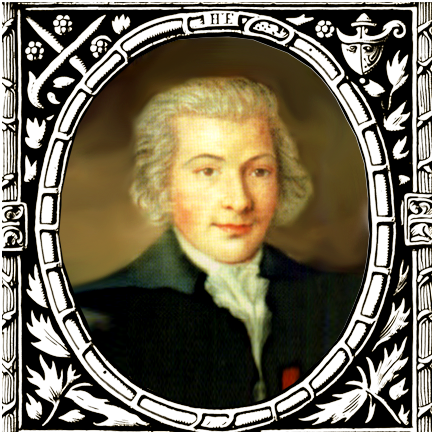
Jean-Baptiste Prévôt-de-Sansac (Ivan Ivanovych) Marquis de Traversay
1752-1831
A Freemason of the French Lodges, he was a captain of the French navy who had managed to fight for the independence of the USA.In 1791 he was accepted into the Russian service with the rank of major general, and until 1800 he served in the squadron of V. von Dezin.
In 1801 he received promotion to admiral, and in 1802 he was appointed Chief Commander of the Black Sea Fleet and of the ports, and military governor of the cities of Mykolaiv and Sevastopol.
Traversay not only intensified shipbuilding on the Black Sea, but also paid attention to the revival of culture: he opened a printing house, a school for naval cabin boys in Mykolaiv, a "Cabinet of Antiquities" (the first museum in the city), supported the first amateur theater in Mykolaiv, and laid out in the city a botanical garden with a greenhouse.
In 1809-28 he was administrator of the imperial Naval Ministry - Minister of the Navy, and a member of the State Council.
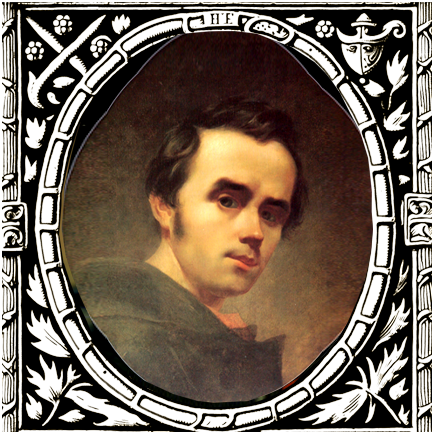
Taras Hryhorovych Shevchenko
1814-1861
Whether the Ukrainian poet, prose writer, thinker, painter, ethnographer, public figure, National hero and symbol of Ukraine, member of the Cyril and Methodius Brotherhood was a participant in one of the Masonic Lodges is not known for certain. But the facts from the biography of his life - the redemption from serfdom, the constant social and fraternal milieu - speak in favor of his indisputable belonging to the Order.The literary legacy of Shevchenko is regarded as the foundation of modern Ukrainian literature and of the literary Ukrainian language. The life of Taras Shevchenko is a didactic legend, a democratic program of liberty, equality, and fraternity.
His life is mythologized and therefore shrouded in mysteries. But "the king is made by his entourage." When Shevchenko was in prison and in soldiery, his name was on everyone's lips, and with particular force it "began to work" after his death.
All his life Freemasons surrounded him, friends in Saint Petersburg. One of them was Nestor Kukolnyk - the son of a Freemason, a pupil of Fessler. N. Kukolnyk was expelled from the Nizhyn Gymnasium in the "affair concerning free-thinking." At the Nizhyn Lyceum, where Freemason-teachers figured, and among them the pupil of Fessler - I. Orlai.
Friendship with "teachers" - "theoretical" Freemasons (V. Zhukovsky). Another friend of the young Shevchenko was the Ukrainian nobleman Petro Martos, who was also expelled from the Nizhyn Gymnasium in the "affair concerning free-thinking." Martos came from a Masonic family.
Among the closest relatives of M. Glinka - another friend of the Kobzar - there were also Freemasons. The teacher-mentor, a kind of "guru" of T. Shevchenko, became K. Briullov - "Charlemagne," who gave Taras not only a "school" and lodging, but also a portion of his commissions!
Then came the almost biblical parable of the "redemption of Taras from bondage" - from serfdom. N. Kukolnyk turned to the Freemason V. Zhukovsky (the celebrated poet, actual state councilor, a man close to the tsar's family); V. Zhukovsky went to the tsaritsa (the haste and the level of resolution of the matter concerning a serf!), and the tsaritsa herself ordered the landowner Engelhardt to halt the sale of Taras into "other hands." Briullov painted a portrait of V. Zhukovsky, which was to be put up for a lottery in order to gather the unheard-of "price" for the serf Shevchenko - 2,500 rubles!
In the liberation of Shevchenko an active part was taken by Freemasons, not only the members of the first degrees N. Kukolnyk, P. Martos, but also the pillars of the Order: K. Briullov, V. Zhukovsky, V. Hryhorovych (professor and conference-secretary of the Academy of Arts, to whom the poet dedicated the poem "The Haidamaks"), Count Mikhail Vielgorsky (the head of theoretical Freemasonry of the whole empire, the master of the horse of the court, actual state councilor), Count F. Tolstoy (actual state councilor, vice-president of the Academy of Arts). For this lottery they took a loan from the bank, and on April 22, 1838, the "consecration" of Shevchenko as a free man took place.
They continued to care for Taras in his later "free" life as well. Briullov gave him a portion of his commissions for portraits. P. Martos printed free of charge the first poetic collection of T. Shevchenko, "Kobzar" (without any hope that the expenses would be recouped), and the censor Korsakov, a close relative of Martos, did everything so that in 1840 "Kobzar" might see the light.
In the middle of the 1840s the former serf became "one of their own" on the estates of the aristocracy. He was a welcome guest at the Kapnists (a Masonic family from time immemorial), the Lyzohubs, and the aristocrat and recent "master of Little Russia" Prince M. Repnin. T. Shevchenko was for a long time a guest on the estate of Sedniv of Illia Lyzohub - a Freemason from 1817. Not only his astonishing talent, but also the Masonic "fraternal chain," brought Taras into the circle of the potential benefactors of his future books.
The Freemasons discerned in Shevchenko a future national genius, redeemed him, led him through life - "hewed this stone," organized his publication and his image even after his death. At the beginning of the 20th century one of the Ukrainian Masonic Lodges bore the name "Shevchenko."
Taras Shevchenko called for the creation of an enlightened government, wishing for his Homeland to "await its Washington" (it was known to Shevchenko that Washington was a Freemason). In the middle of the 1840s Shevchenko sought to establish a connection with the Polish political figure and Freemason M. Czajkowski, who in the Danube floodlands was organizing Cossacks for a campaign against Emperor Nicholas I. Shevchenko handed Czajkowski the manuscript of his poem "The Haidamaks," regarding Czajkowski as his inspirer.
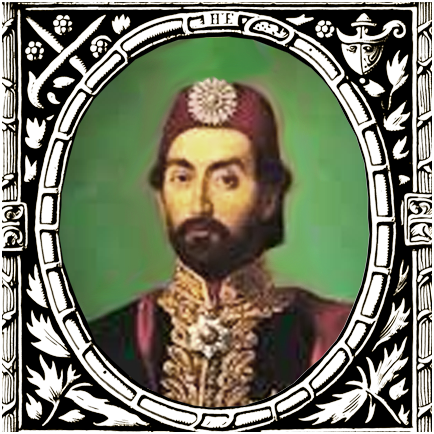
Michal Czajkowski
1804-1886
A Polish writer and political figure of the Ukrainian nobility. A representative of the "Ukrainian school" in Polish literature. In his "first life" M. Czajkowski, born into a noble family in the Zhytomyr region, was a member of the Masonic Lodges and of the Patriotic Society, a participant in the Polish uprising of 1830-32. After the defeat of the uprising he moved to Paris.
In Paris Czajkowski became closely acquainted with Adam Mickiewicz, and published his book "Cossack Tales," which shocked many Poles with its anticlericalism. In 1841 Czajkowski moved to Istanbul, converted to Islam, and accepted Turkish citizenship, establishing contacts with Shamil, and seeking to organize an uprising in Ukraine with the help of Cossacks from the delta of the Danube.
Czajkowski organized in Turkey a colony of Polish emigrants - Adampol (named in honor of Czartoryski). When in 1853 the war of Turkey, England, and France against the Russian Empire began, Czajkowski, holding the rank of a Turkish pasha, created a Cossack regiment, which went forth against the Russian army near Silistra and was the first to enter Bucharest. A. Mickiewicz came to Turkey to support Czajkowski, but died in Czajkowski's camp of cholera during an epidemic.
Czajkowski, in his "My Recollections of the War of 1854," asserted that he was presented with a petition by the leaders of a certain secret "Committee of Ukraine and Bessarabia" with proposals to restore Ukrainian Cossack statehood.
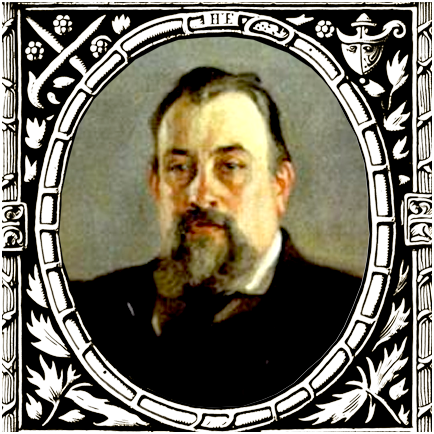
Maksym Maksymovych Kovalevsky
1851-1916
He was born in Kharkiv, graduated from the juridical faculty of Kharkiv University, and began to teach there. He underwent his preparation for the master's examination at the universities of Berlin, Paris, and London. In 1880 he defended a doctoral dissertation in law and became a professor, and eight years later the Russian Academy of Sciences elected him a corresponding member (in 1914 an academician).
M. Kovalevsky was elected a member of the French Academy of Moral and Political Sciences and a member of the Toulouse Academy of Legislation. In 1887 M. Kovalevsky was dismissed from Moscow University for his "negative attitude toward the Russian state order." He taught at the universities of Stockholm and Brussels and delivered lectures in Paris, Oxford, and in the cities of the USA.
In Paris the Freemason M. Kovalevsky organized the attraction and admission into the Masonic Order of liberal figures from the Russian Empire, who were the foundation of Russian "political" Freemasonry of 1906-16. Mykhailo Hrushevsky, precisely under the influence of M. Kovalevsky, in 1903 became a Freemason in one of the Lodges of Paris.
Having returned to the Russian Empire (1906), M. Kovalevsky worked as professor of Saint Petersburg University and of the Psychoneurological Institute, organized the Party of Democratic Reforms and the Kadet party, was elected to the 1st State Duma (from the Kharkiv Governorate), and became a member of the State Council, a state councilor.
He organized the house-museum of L. Tolstoy in Saint Petersburg, headed the Shevchenko society and the Saint Petersburg branch of the Society of Peace, the Saint Petersburg Juridical Society, and from 1909 published the journal "Herald of Europe."
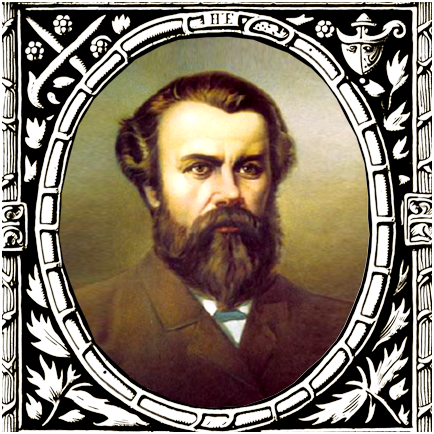
Mykhailo Petrovych Drahomanov
1841-1895
He came from the Sloboda Cossacks. In 1808 he became a Freemason of the Swiss and Italian Lodges. A Ukrainian political figure, publicist, and social theorist.From 1864 Drahomanov collaborated with the "Saint Petersburg Gazette," which was edited by the Freemason V. F. Korsh. After defending his master's dissertation, Drahomanov was elected a regular docent of Kyiv University, and later went abroad to continue his scholarly studies.
In 1870-73 M. Drahomanov lived in Berlin and Vienna, Florence, and Paris. Having returned to Kyiv, M. Drahomanov found himself in the circle of the Ukrainophiles, who were forming the "Hromada" and publishing the newspaper "Kyiv Telegraph."
In September 1875 M. Drahomanov was dismissed from the university as "unreliable," which pushed him toward emigration abroad, where he lived until his very death (1876-95), having laid the beginning both of the Ukrainian emigration and of the Ukrainian émigré press. In Geneva M. Drahomanov became absorbed in the ideas of Herzen, Ogarev, and Bakunin, and published articles on questions of ethnography and history. The closest friend of M. Drahomanov was the Ukrainian genius Ivan Franko (a Freemason), who shared his views on many spiritual and social questions.
Mykhailo Drahomanov was captivated by the problem of global reform, the reconstruction of existing societies, the establishment of social justice and spiritual culture. He believed that the social order ought to serve the free and harmonious development of the individual.
The new structure was to become a structure of "Astraea" - of justice and freedom, where "free individuals" united on voluntary principles into associations, organized into a federal union with maximal decentralization and self-governance.
And society itself is created from below, by the initiative of "individual personalities." The "free personality" was his ideal and his "spiritual service."
The prospects of Ukraine, Drahomanov saw in the upbringing of a democratic European nation, in the striving to organize society after the example of Holland, England, and the Swiss Cantons. He believed that not revolution, but accelerated evolution, which is guided, could change the world for the better.
A new just order could arise only through the inner changes of concrete people. At the same time, Drahomanov was indignant at the attempt of the figures of the "hromadas" and the "narodovtsi" to limit national activity to the development of culture alone.
He believed that the people needed help in the matter of self-organization and the transition to new worldview positions; he dreamed of reforming Orthodoxy in Ukraine and creating a new honest Church.
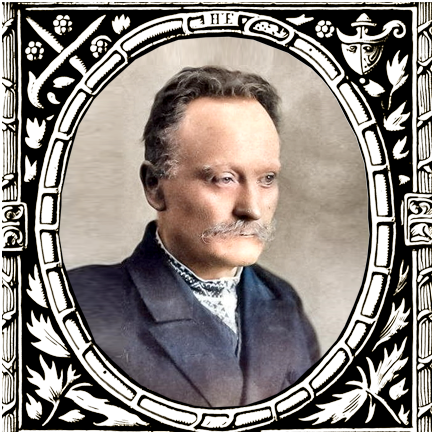
Ivan Yakovych Franko
1856-1916
An eminent Ukrainian poet, prose writer, dramatist, literary critic, publicist, translator, scholar, art historian, ethnologist and folklorist, historian, sociologist, political scientist, economist, philosopher, and public and political figure.Doctor of philosophy, habilitated doctor, full member of the Shevchenko Scientific Society, honorary doctor of Kharkiv University.
His creative output, written in Ukrainian (the majority of the texts), Polish, German, Russian, Bulgarian, and Czech, by approximate estimates numbers several thousand works of a total volume of more than 100 volumes.
In all, during Franko's lifetime there were more than 220 editions in separate books and brochures, including more than 60 collections of his original and translated works of various genres.
For his public and political activity, which was qualified as socialist propaganda, Franko was imprisoned 4 times by the Austrian authorities. Because of the first arrest he was forced to interrupt his studies at the University of Lviv; however, he resumed them in 1878-1879, having attended in all 7 semesters. He completed his full higher education later. In 1890-1891, while studying at the University of Chernivtsi, he became one of the founders and the first head (until 1898) of the Ruthenian-Ukrainian Radical Party (RURP) - the first Ukrainian political party - and editor of its printed organs, the newspapers "Narod" (1890-95), "Khliborob" (1891-95), and "Hromadskyi Holos" (from 1895).
Three times he stood as a candidate of this party in the elections to the Galician Sejm and the Austrian parliament (1895, 1897, 1898), each time unsuccessfully. In 1893 at the University of Vienna, under the direction of the renowned Slavicist V. Jagić, he defended the dissertation "Barlaam and Josaphat, an Old Christian Spiritual Romance and its Literary History," and obtained the scholarly degree of doctor of philosophy; and his programmatic poem "The Stonecutter" became the Masonic hymn of the Grand Lodge of Ukraine.
Franko's "Stonecutter," filled with Masonic symbolism, where the "voice of the dawn" is the will of the Absolute or of the Architect, and the iron chain on the "thousands" of stonecutters is the Fraternal chain of mutual aid - the chain of the Masonic oath. Instead of the Masonic slogan "hew the stone," I. Franko calls: "break this rock." A member of a number of Masonic Lodges of the Austro-Hungarian Empire.
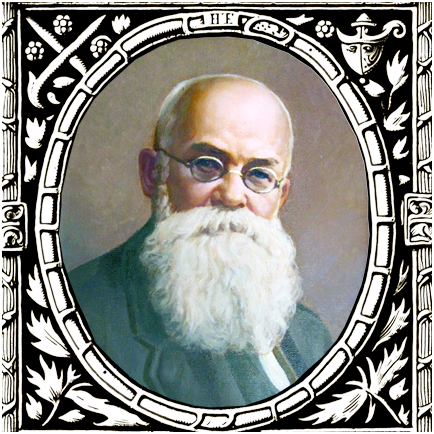
Mykhailo Serhiiovych Hrushevsky
1866-1934
The ideologist of the Ukrainian national revival, the "father" of Ukrainian history, a public and political figure. A builder of independent Ukraine in 1917-18, head of the Central Rada of the UPR, corresponding member of the All-Ukrainian Academy of Sciences and of the Academy of Sciences of the USSR; from 1894 professor of the chair of world history at the University of Lviv.Together with Ivan Franko he entered the Ukrainian National-Democratic Party.
While in Paris, in 1903 he joined a French Masonic Lodge and headed a group of Ukrainian Freemasons, which saw the possibility of the existence of a democratic Russia only as an "equal federation of all the peoples that are part of the Russian Empire," while assigning to Ukraine the rights of a confederative State. He was the leader of Freemasonry in the Ukrainian governorates (part of the Freemasons of the Kyiv, Yekaterinoslav, Chernihiv, and Poltava Lodges).
In the summer of 1912, at the Masonic Convent of the Lodges of the "Grand Lodge" of the empire, three deputies from Ukraine (the group of Hrushevsky) spoke out against the approval of the proposed name for the all-Russian Masonic organization - the "Grand Orient of Russia."
These deputies did not agree with such a name, since in it, as it seemed to them, there was present a "Russian great-power chauvinism." M. Hrushevsky proposed to remove the word "Russia" from the name of the chief Masonic structure of Eastern Europe in connection with the striving of the peoples of Russia for political self-determination.
The Convent went for a compromise. It was decided to change the name of the chief Masonic structure to the "Grand Orient of the Peoples of Russia." M. Hrushevsky wrote: "The Masonic organization worked broadly, it realized its long-adopted tactical plan - in every sort of political possibility to use its connections and to advance its people to influential posts."
M. Hrushevsky and his like-minded associates entered into conflict with the Freemason A. Kerensky on the question of the creation of a national state. He headed the UPR until the end of April 1918. At the beginning of 1918 he departed from Freemasonry, and at the beginning of the 1920s he departed from political activity.
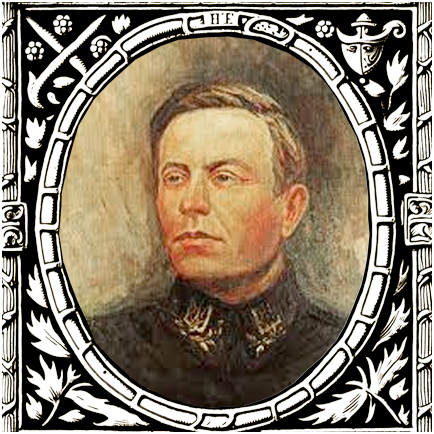
Symon Vasylovych Petliura
1876-1926
The ideologist of the Ukrainian national revival, a public and political figure, a builder of independent Ukraine in 1917-20, one of the leaders of the Central Rada of the UPR and of the Directorate of the UPR, the Chief Otaman (commander-in-chief of the forces of the UPR).From his early youth he went into the Ukrainian liberation movement, became a member of the Revolutionary Ukrainian Party, and one of the leaders of Ukrainian social democracy (elected a member of the Central Committee of the USDRP).
In 1904 S. Petliura emigrated to Galicia and became co-editor of the newspapers "Selianyn" and "Robota," editor of the social-democratic weekly "Slovo," and co-editor of the newspaper "Slovo."
It was precisely in 1906 that S. Petliura joined one of the Kyiv Masonic Lodges. Having moved to Moscow, S. Petliura edited the Russian-language journal "Ukrainian Life" (1912-14). In 1915 S. Petliura became the plenipotentiary of the Zemstvo Union in the 3rd Army, at first assistant to the chief quartermaster of front-line supplies, and later head of the Control Collegium of the Zemstvo Union on the Western Front.
With the beginning of the February Revolution of 1917 he became the initiator of the holding of the Ukrainian Congress of Soldiers of the Western Front, at which he was elected head of the Ukrainian Front Council; he again became a member of the Central Committee of the USDRP.
At the First All-Ukrainian Military Congress, S. Petliura was elected head of the Ukrainian Main Military Committee, in May 1917 a member of the Central Rada, and a member of the General Secretariat (the government) of Ukraine (taking charge of the Ukrainization of the forces). On October 31, 1917, he was appointed General Secretary (Minister) of Military Affairs of the Ukrainian Republic.
He commanded the Ukrainian forces that occupied Kyiv, suppressed the Bolshevik uprising, and supported the authority of the Central Rada. On November 30, 1917, under the leadership of S. Petliura, all the Bolshevik military formations in Kyiv were disarmed, a Bolshevik coup was averted, and on December 5, 1917, S. Petliura prevented the seizure of the First All-Ukrainian Congress of Soviets by the Bolsheviks. On December 18, 1917, S. Petliura was forced to submit his resignation from the post of General Secretary of Military Affairs. Already as a private person, from January 1918 S. Petliura began to organize the Haidamaka Kish of Sloboda Ukraine - a volunteer military unit for the struggle against the advance of the Reds on Kyiv.
The Haidamaka Kish fought near Poltava against the advancing Red forces, liquidated the Bolshevik uprising at the "Arsenal" factory in Kyiv, and defended Kyiv from the Red forces.
In 1918 he headed the All-Ukrainian Union of Zemstvos. On July 27, 1918, for an anti-hetman manifesto with the demand for the liquidation of landed estate ownership and the return of the land to the peasants, he was arrested. On November 12, 1918, he was released and elected a member of the Directorate of the UPR and Chief Otaman of the Forces of the UPR. On May 9, 1919, he was elected Head of the Directorate (the actual head of the Directorate of the UPR from February 1919).
From the beginning of 1919 he intensified the creation of the Grand Lodge of Ukraine, and in the spring of 1919 in Kamianets-Podilskyi the "Grand Lodge of Ukraine" was proclaimed.
The Grand Master of the Grand Lodge (the first Grand Master of Ukrainian Freemasonry) became S. Petliura. The Grand Lodge of Ukraine turned to the French Freemasons with a request to assist in the international recognition of the Ukrainian state.
S. Petliura believed that Ukraine ought to become an example of a "Masonic republic." The Grand Lodge of Ukraine was joined by Freemasons - adherents of Ukrainian independence. These were predominantly Ukrainian federalists, Ukrainian Socialist-Revolutionaries, and Ukrainian social-democrats: Andrii Lyvytsky (vice-premier and minister of justice of the Directorate) became the Grand Secretary of the Grand Lodge, Vsevolod Petrov (general, commander of the Volhynian army group) the 1st Guardian, Franz More the 2nd Guardian; masters of the Lodge were A. Nikovsky, S. Shelukhin, S. Yefremov, A. Shulhyn, Ya. Kotliarevsky, M. Shumnytsky, V. Prokopovych.
Petliura asked the international Freemasonry to recognize the Grand Lodge of Ukraine as the "highest Masonic authority, an independent power on the territory of the Ukrainian Republic" and to include it in the International Bureau of Masonic Relations.
In April 1919 - November 1920, the head of the Directorate, S. Petliura, formed the cabinets of ministers of the UPR, in which the premiers were the Freemasons V. Prokopovych and A. Lyvytsky; the Freemasons A. Shulhyn, P. Salykovsky, P. Kholodnyi, and A. Nikovsky held ministerial posts.
From November 1920 he directed the work of the government of the UPR in exile. In October 1924 he settled in Paris, where he continued to perform the duties of head of the Directorate of the UPR and Chief Otaman of the UPR. He was killed on May 25, 1926, by an OGPU agent, S. Schwartzbard.
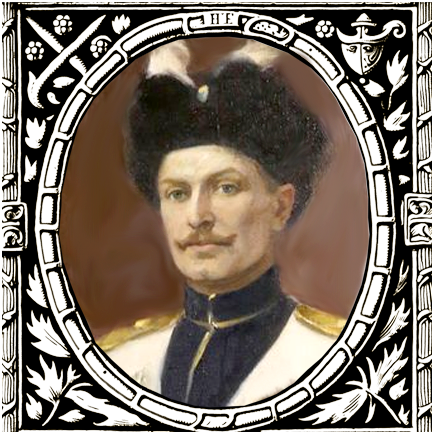
Pavlo Petrovych Skoropadsky
1873-1945
A descendant of one of the hetmans of Ukraine of the 18th century, he was hetman of the Ukrainian State from April 29 to December 14, 1918.There is testimony that he was a Brother in the Masonic Lodges "Young Ukraine," "Andrew the First-Called," "Saint Volodymyr," "Narcissus."
On April 30, 1918, power in Ukraine passed by means of a military coup to Hetman P. Skoropadsky (who removed from power M. Hrushevsky and the Central Rada), who liquidated the republican institutions and proclaimed his dictatorship in the form of the omnipotence of the hetman of the Ukrainian State.
On May 1, 1918, the hetman appointed as temporary acting head of the Council of Ministers M. Vasylenko (the Worshipful Master of the Kyiv Lodge "Astraea"), who drew up his list of ministries, the heads of which were for the most part Freemasons.
From May 1918 Skoropadsky appointed the Freemason F. Lyzohub as the new prime minister of the Ukrainian State. Of the fourteen ministers of the first cabinet of hetman ministers, seven were Freemasons (F. Lyzohub, D. Doroshenko, M. Chubynsky, M. Vasylenko, V. Zenkovsky, I. Kistiakivsky, H. Afanasiev).
In the second cabinet of F. Lyzohub, of the fourteen ministers five were Freemasons (F. Lyzohub, D. Doroshenko, A. Lototsky, P. Stebnytsky, A. Viazlov). A notable influence on Hetman Skoropadsky was exerted by his personal secretary with unlimited powers - the leader of the Martinist Freemasons S. Morkotun - and the leader of the Kyiv Freemasons, one of the leading workers of the hetman's ministry of foreign affairs, Baron Steingel.
Volodymyr Musiiovych Chekhivsky
1876-1937
A Ukrainian political and public figure, prime minister of the UPR. One of the founders of the UAOC, a deputy of the State Duma of the Russian Empire. He graduated from the Kyiv Theological Academy and was part of the student circle of Ukrainian social-democrats - the "Drahomanovites."Assistant to the inspector of the Podilia, and later the Kyiv, theological seminaries; a teacher of the history of literature and the theory of letters at a men's gymnasium.
In 1902-1904 he was a member of the Revolutionary Ukrainian Party, and then a member of the Ukrainian Social-Democratic Workers' Party. In 1908-17 he taught at a gymnasium and at the commercial and technical colleges in Odesa. From 1915 he was a member of the Masonic Lodge "Star of the East" in Odesa.
In 1917 he became editor of the newspaper "Ukrainian Word," headed the Odesa committee of the USDRP, and was a member of the Ukrainian Council from Odesa. From the summer of 1917 he was a councilor of the Odesa City Duma, headed the Kherson Provincial Council of United Public Organizations and the Odesa Revolutionary Committee.
From November 1917 he was political commissar of Odesa and provincial commissar of education of the Kherson region. In 1918 he was elected a member of the Central Committee of the USDRP and director of the department of confessions with the rights of a minister in the government of the UPR. During the uprising against the hetman regime in December 1918, he headed the Ukrainian Revolutionary Committee.
From December 26, 1918, to February 11, 1919, he was head of the Council of Ministers and minister of foreign affairs of the UPR. He remained on the territory of Ukraine after its capture by the Red Army. In October 1921 he took part in the All-Ukrainian Church Council, which confirmed the autocephaly of the Ukrainian Autocephalous Orthodox Church.
He was an adviser to the metropolitan of the Ukrainian Autocephalous Orthodox Church and an evangelist (preacher) in the UAOC, one of the chief ideologists of Ukrainian church autocephaly, and an adherent of Christian socialism. In 1929 he was arrested in the affair of the "Union for the Liberation of Ukraine," sentenced to execution by firing squad, commuted to a 10-year imprisonment. He was shot in 1937.
Veniamin Fedorovych Kahan
1869-1953
A mathematician, he graduated from the physics and mathematics faculty of Kyiv University, and in 1897-1920 worked at the university in Odesa as a privatdozent of the chair of pure mathematics.Already at the age of 18, having become absorbed in the geometry of Lobachevsky, he published the scholarly work "On Inverse Figures." The student of the physics and mathematics faculty of Novorossiya University, V. Kahan, was expelled from the university for taking part in "student disorders." He was deprived of the right of admission to institutions of higher learning and was expelled from Odesa "under police surveillance." Only in 1897 was he permitted to teach at Novorossiya University, where he delivered the first course in the history of Russian universities, the "Theory of Relativity."
In 1901-17 he was the chief editor of the journal "Herald of Experimental Physics and Elementary Mathematics," in connection with which there also operated the scholarly publishing house "Mathesis."
One of the founders of a private European men's gymnasium and of the Odesa Higher Courses for Women, and dean of the physics and mathematics faculty. He took part in the founding of the Odesa Physics and Mathematics Institute.
At the Odesa Institute of Public Education he worked as professor and head of the first chair of geometry in Odesa. He published the "Journal of Pure and Applied Knowledge" and the "Journal of the Odesa Higher School." In 1906-1918 he was a Brother of the Odesa Masonic Lodges.
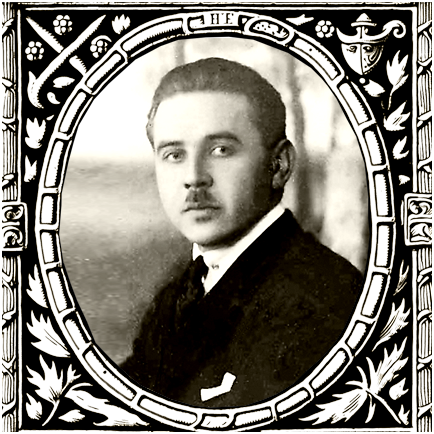
Andrii Vasylovych Nikovsky
1885-1942
A Ukrainian public and political figure, minister of foreign affairs in the government of the UPR.A literary scholar, linguist, and journalist.In 1912 he moved to Kyiv to the post of editor of the newspaper "Rada." In 1914-16 he was editor of the "Literary-Scientific Herald," of the journal "Osnova" in Odesa, and of the almanac "Step," secretary of the Odesa "Prosvita," and a member of the party of Ukrainian Socialist-Federalists. In 1917 he was elected to the Ukrainian Central Rada from Odesa, deputy head of the Central Rada, and head of the Ukrainian National-State Union (UNSU).
He emigrated together with the government of the UPR to the Polish Republic, where in 1920 he held the post of minister of foreign affairs of the UPR. In 1929, together with S. Yefremov, he was imprisoned, and sentenced in 1930 as one of the leaders of the "Union for the Liberation of Ukraine."
The death sentence pronounced on Nikovsky at the trial was commuted to eight years of imprisonment. A Brother of the Masonic Ukrainian lodges in 1913-1922.